About Australoheros facetus (Jenyns, 1842)
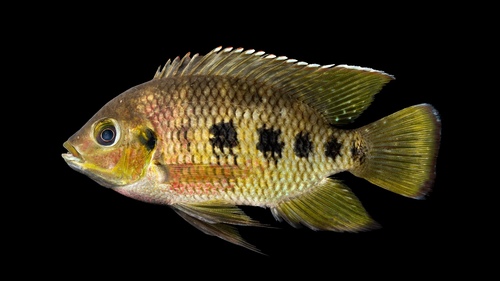
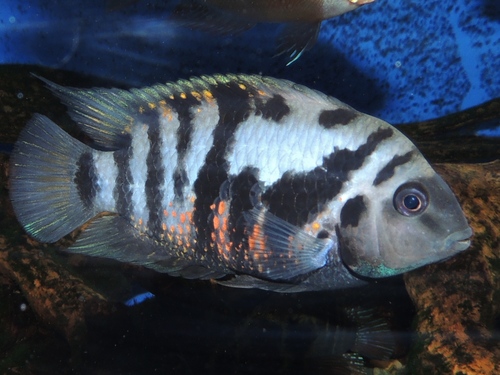
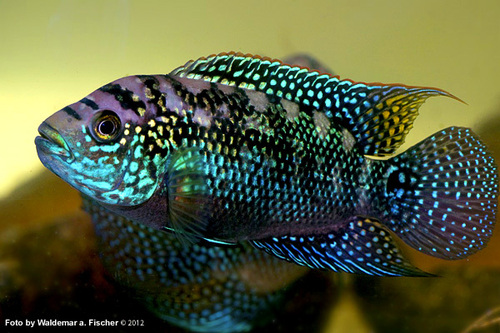
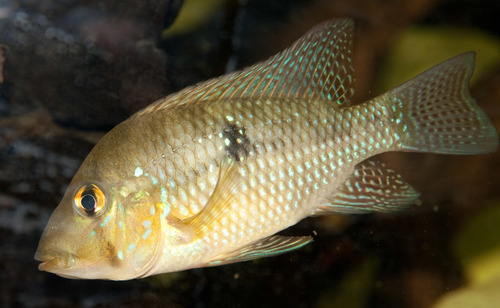
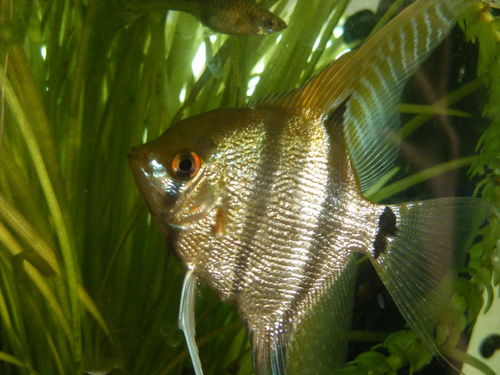
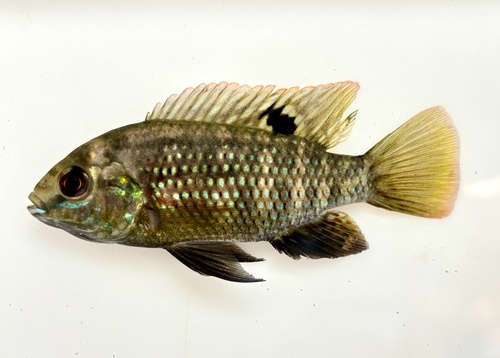
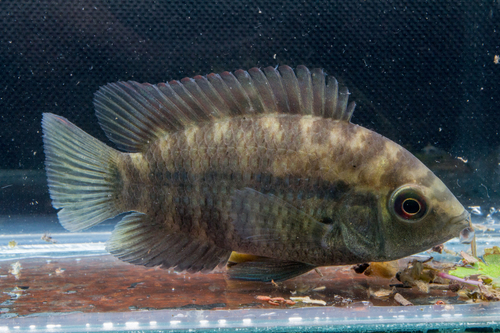
Australoheros facetus has a high, deeply compressed body covered in large scales. It has a small, upward-pointing mouth, where the jaws do not extend past the forward margin of the eye. It has a long dorsal fin that extends to two-thirds of the fish’s total length, and its caudal fin is rounded in shape. It can be distinguished from other species in the genus Australoheros by its longer lower jaw, upward-pointing mouth, the shortest dorsal scale cover, and the fewest scales on the dorsal and anal fins. 80% of A. facetus specimens have four abdominal bars; this feature is only present in half of individuals of its close related species. Normally, this fish reaches 18 centimetres (7.1 in) in length, though males have been recorded growing up to 60 centimetres (24 in). Its body colour varies from brassy yellow through greenish to even black, and it is normally marked with a number of dark transverse bands. Males are larger than females and have larger fins. The native range of Australoheros facetus includes the Río de la Plata Basin in Argentina, Brazil, Paraguay and Uruguay, as well as the coastal drainages of Uruguay, Rio Grande do Sul in Brazil, and Buenos Aires in Argentina. It has been introduced and has become established in southern Iberia and Chile. It has also been introduced to Germany and the Philippines; it failed to establish a population in Germany, and its status in the Philippines is unknown. Australoheros facetus is a freshwater species that lives in creeks, rivers, swamps and lakes. It is a diurnal, omnivorous, rather opportunistic feeder. Its diet includes detritus and plants; it preys on small aquatic animals including small fish, and feeds mainly on molluscs and insect larvae. It can tolerate low temperatures. A. facetus has been recorded as a host for the trematode Centrocestus formosanus, an intestinal parasite of piscivorous birds and mammals that is known to infect humans in its native Asian range. Chameleon cichlids lay their eggs in the open on a stone or piece of wood. Both parents care for the eggs and fry for up to three weeks, and eggs hatch 2–4 days after being laid. In rivers where this species has been introduced in Europe, it spawns when the water temperature rises above 28–30 °C (82–86 °F). Pairs form for spawning, and both sexes are territorial. In Iberia, breeding occurs between April and June.