About Auriparus flaviceps (Sundevall, 1850)
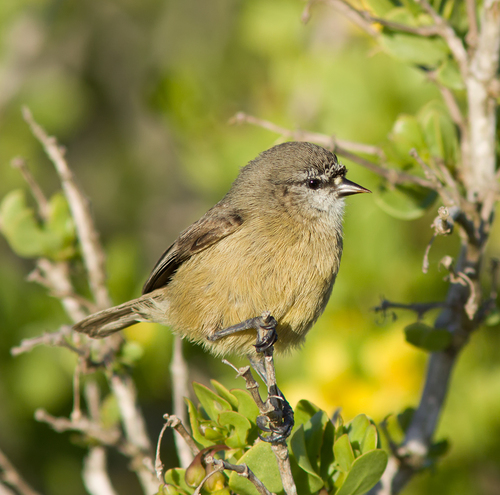
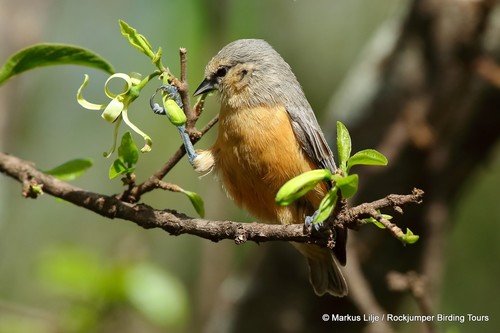
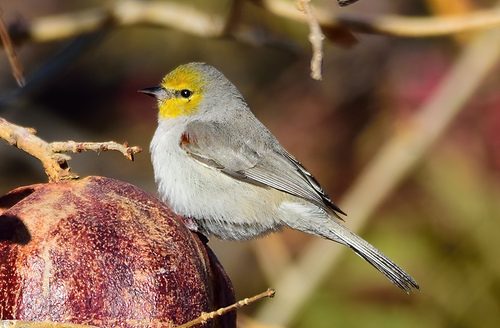
Description: The verdin (Auriparus flaviceps) is a very small bird, measuring 4.5 inches (11 cm) in length. It rivals the American bushtit as one of the smallest passerine birds in North America. Its overall plumage is gray. Adult verdins have a bright yellow head and a rufous shoulder patch, which is the lesser coverts of the wing. Unlike tits, the verdin has a sharply pointed bill; the base of its short bill is thick at the head, and tapers to a sharp point at the tip. Juvenile verdins have a light gray body, and lack both the rufous shoulder patch and yellow head seen in adults. Distribution and habitat: Two subspecies of verdin nest in the United States. Subspecies A. f. acaciarum is a permanent resident ranging from southern California, Nevada, and Utah south into Mexico, and is most commonly associated with the Sonoran Desert. Subspecies A. f. ornatus is found from New Mexico and Oklahoma south into Mexico, and is associated with the Chihuahuan Desert and its scrublands. The remaining 4 to 5 subspecies are permanent residents of Mexico, and are not known to migrate into the United States. Verdins build their nests in shrubs and thorny thickets with few trees. Their nests are spherical masses made of bulky twigs and branches, lined inside with grasses, feathers, and hair. The entrance to the nest is about 1 inch in diameter, and is usually located at the bottom of the spherical nest. Verdins forage for food in shrubland and scrubby outcrops that host insects and have plentiful berries and seeds. Food and feeding: Verdins are insectivorous, and continuously forage among desert trees and shrubs. They will occasionally visit hummingbird feeders to drink sugar water. They eat many types of tiny insects, including both adult insects and their larvae, and also consume hard and soft mast from many species of trees and shrubs.