About Auricularia mesenterica (Dicks.) Pers.
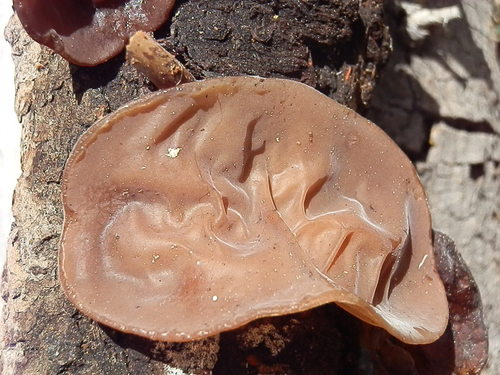
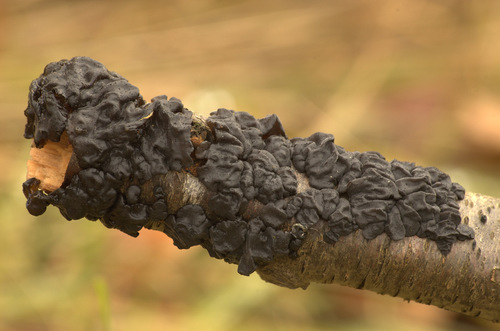
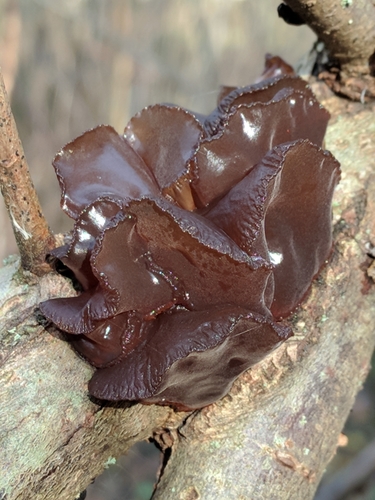
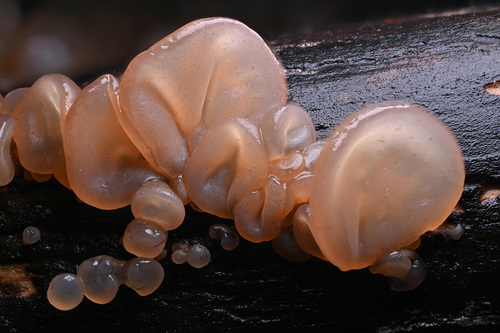
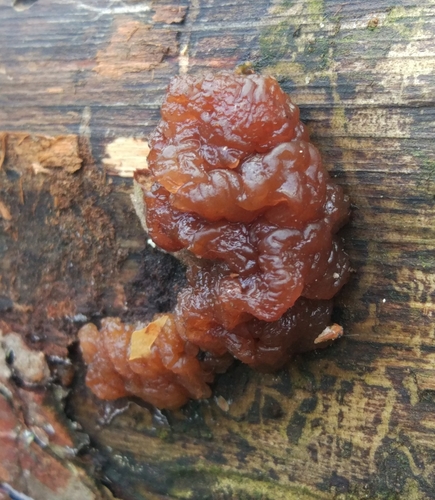
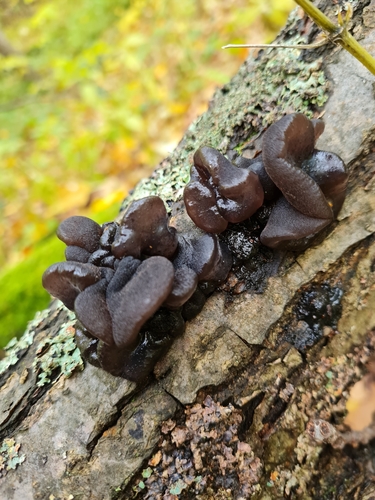
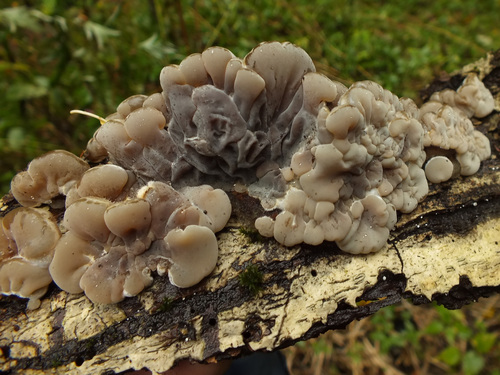
Auricularia mesenterica (Dicks.) Pers. produces bracket-like fruit bodies. Young fruit bodies are pale, rubbery, and button-shaped, expanding to 3 to 7 cm (1.2 to 2.8 in) across and hardening as they age. Fruit bodies frequently merge into larger compound structures that sometimes grow along fallen trunks and branches for more than 1 metre (3.3 ft). The upper surface of the fruit body ranges from grey to brown or buff, with a tomentose to hispid texture and concentric zoning. The underside is thickly gelatinous, marked by irregular radial folds, and coloured reddish brown. This species produces a white spore print. Microscopically, its basidia are auricularioid, meaning they are tubular with three lateral septa, and its basidiospores are allantoid, or sausage-shaped, measuring 14 to 17 by 4.5 to 5 μm. Originally described from England, Auricularia mesenterica is confirmed to occur across Europe and into Central Asia as far east as Uzbekistan. Its basidiocarps grow on stumps and logs from a variety of deciduous tree species. Young, unhardened specimens of Auricularia mesenterica are reported to be edible. However, fungal populations in some locations bioaccumulate high levels of heavy metals from their environment. Studies have found that Auricularia mesenterica contains high levels of phenols and flavonoids, has notable antioxidant activity, and shows potential as an antitumor agent.