About Auricularia auricula-judae (Bull.) Quél.
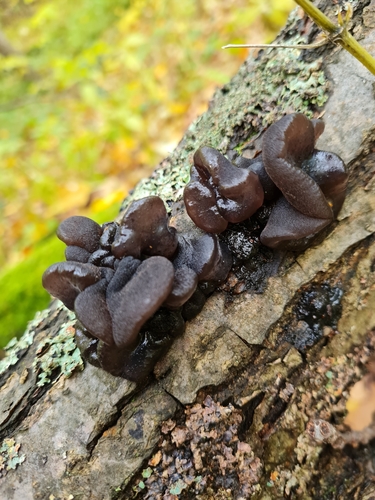
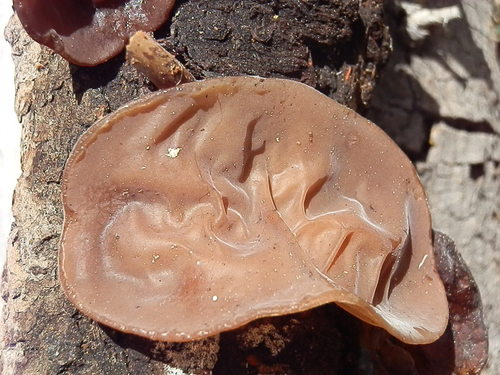
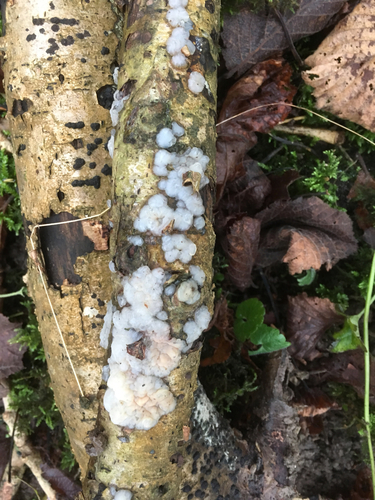
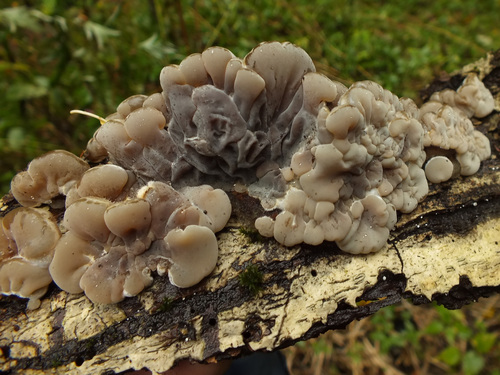
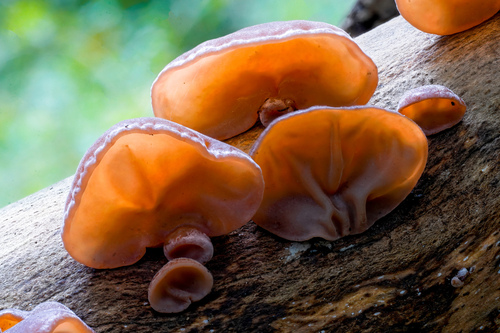
The fruit bodies of Auricularia auricula-judae (Bull.) Quél. are typically up to 9 cm (3+1⁄2 in) across and up to 3 mm (1⁄8 in) thick. Their shape often resembles a floppy ear, but they may also be cup-shaped. They attach laterally to their growing substrate, and sometimes attach via a very short stalk. When fresh, fruit bodies have a tough, gelatinous, elastic texture, while dried fruit bodies become hard and brittle. The upper surface is reddish-tan-brown with a purplish tint, and is finely pilose, meaning it is covered in tiny, grey, downy hairs. Young specimens usually have a smooth upper surface, while older specimens may have an undulating surface marked by folds and wrinkles. The colour of the fungus darkens as it ages. The lower under surface is lighter grey-brown, smooth, and sometimes folded or wrinkled; it may also develop "veins" that make the fungus look even more ear-like. Completely white fruit bodies are found occasionally, and were once classified as the separate species Auricularia lactea. These are just unpigmented forms of A. auricula-judae, and often grow alongside normally pigmented fruit bodies of the species. Auricularia auricula-judae grows on the wood of deciduous trees and shrubs, most commonly on Sambucus nigra (elder). It is also frequently found on Acer pseudoplatanus (sycamore), Fagus sylvatica (beech), Fraxinus excelsior (ash), and Euonymus europaeus (spindle). One unusual recorded growth location is a sycamore draining board from an old sink in Hatton Garden. The species very rarely grows on conifers. It prefers older branches, growing as a saprotroph that feeds on dead wood, or as a weak parasite that grows on living wood, and causes white rot in the wood it grows on. It commonly grows alone, but may also grow in groups or dense tufts. Spores are released from the underside of fruit bodies at rates as high as several hundred thousand per hour. This high release rate continues even after the fruit bodies have become significantly dried. Fruit bodies continue releasing a small number of spores even after losing 90% of their weight through dehydration. The fungus can be found year-round, but is most common in autumn. Auricularia auricula-judae is widespread across Europe, and has not been confirmed to grow anywhere else. It was previously classified as a variable species with a global distribution, but molecular research using cladistic analysis of DNA sequences has shown that non-European populations belong to separate distinct species. The cultivated "A. auricula-judae" grown in China and East Asia is actually Auricularia heimuer, with a smaller amount being Auricularia villosula. The North American fungus commonly called "A. auricula-judae" that grows on broadleaf trees is Auricularia angiospermarum, while the North American species growing on conifers is Auricularia americana. Auricularia auricula-judae has a soft, jelly-like texture. Although it is edible, it is not considered highly desirable for cooking. One description compares its texture to "eating an Indian rubber with bones in it", and in 19th-century Britain, it was noted that "it has never been regarded here as an edible fungus". It is reported to be commonly eaten in Poland. A related species, Auricularia heimuer, which is widely used in East Asian cooking, has often been misidentified as A. auricula-judae. A. auricula-judae has a mild flavour that many people consider bland. It can be dried and later rehydrated, and often swells to 3–4 times its original dried size during rehydration. The species is not edible raw, and requires thorough cooking before consumption. A 100 g (3.5 oz) reference serving of dried A. auricula-judae provides 1,500 kilojoules (370 kilocalories) of food energy, and contains 10.6 g of protein, 0.2 g of fat, 65 g of carbohydrate, 5.8 g of ash, and 0.03 mg of carotene. Fresh fruit bodies are made up of approximately 90% moisture. Dried specimens can be ground into a powder, which is used to absorb excess liquid in soups and stews as it rehydrates into tiny fragments. Auricularia auricula-judae has been used as a medicinal fungus by many herbalists. It was applied as a poultice to treat eye inflammations, and used as a palliative for throat problems. In 1597, 16th-century herbalist John Gerard recommended A. auricula-judae for this specific sore throat treatment, unlike other fungi that he used more generally for multiple conditions. Gerard's recommended preparation was a liquid extract made by boiling the fruit bodies in milk, or steeping them in beer, that was sipped slowly to cure a sore throat. The resulting broth was likely similar to Chinese soups that use Auricularia cornea. In 1601, Carolus Clusius also stated that the species could be used as a gargle to cure sore throats. In 1640, John Parkinson reported that boiling the fungus in milk or steeping it in vinegar was "the onely use they are put unto that I know". In 1694, herbalist John Pechey described A. auricula-judae, noting it grows on the trunks of elder trees, can be stored for a full year when dried, and when boiled in milk or infused in vinegar makes a good gargle for quinsy and other inflammations of the mouth and throat; infused in suitable water, it is also good for eye diseases. The species was also used as an astringent because of its ability to absorb water. Recorded medicinal uses also come from Scotland, where it was again used as a gargle for sore throats, and from Ireland, where it was boiled in milk to attempt to treat jaundice. Medicinal use of A. auricula-judae continued until at least 1860, when it was still sold for this purpose at London's Covent Garden; at that time, it was not considered edible in the United Kingdom.