About Aureolaria virginica (L.) Pennell
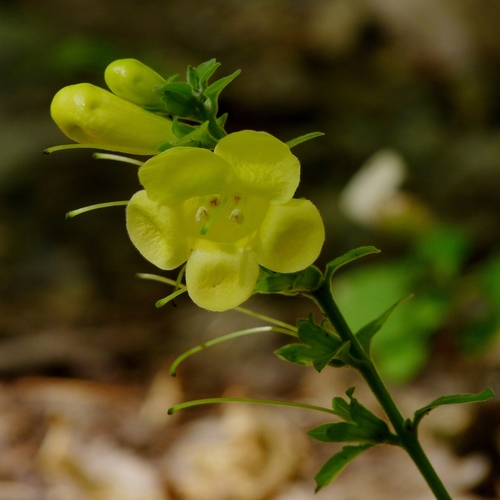
Aureolaria virginica (L.) Pennell grows 50 to 150 centimeters tall, and its entire structure is covered in fine downy hairs. Its leaves range in shape from ovate to lanceolate, measuring 6 to 15 centimeters long and 1.5 to 4.5 centimeters wide; the lower leaves sometimes have lobes or teeth. Flowers grow from pedicels that are 1 to 3 millimeters long. Each flower has five petals that measure 3.5 to 4.5 centimeters long, fused into a corolla tube, and the petals are smooth on the outside. The fruit is a dry, ovoid capsule 1 to 1.5 centimeters long that splits open when it reaches maturity. This species is widely distributed across the eastern United States, though local populations can be scattered. It has been recorded in Alabama, Connecticut, Washington, D.C., Delaware, Florida, Georgia, Indiana, Kentucky, Louisiana, Massachusetts, Maryland, Michigan, Mississippi, North Carolina, New Hampshire, New Jersey, New York, Ohio, Pennsylvania, Rhode Island, South Carolina, Tennessee, Texas, Virginia, Vermont, and West Virginia in the U.S., and in the Canadian province of Ontario. It is listed as a threatened species in the U.S. state of New Hampshire. In Virginia, it grows in dry forests dominated by oak trees. Its survival relies on the presence of suitable habitat; development, changes in land use, or competition from invasive species can eliminate it from a local area. Like other species in the genus Aureolaria, A. virginica is hemiparasitic on oak trees. It may only use Quercus alba as a host. It produces chlorophyll and carries out photosynthesis on its own.