About Aureolaria flava (L.) Farw.
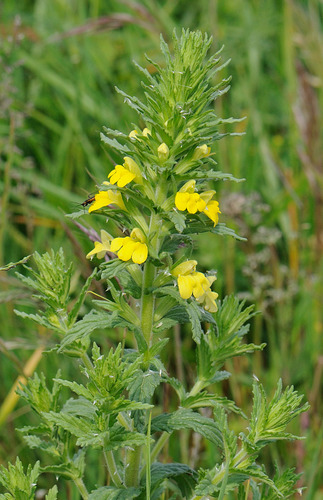
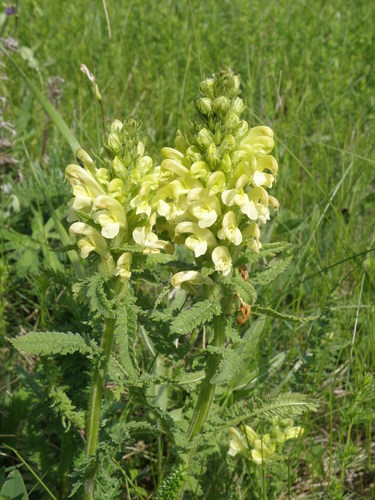
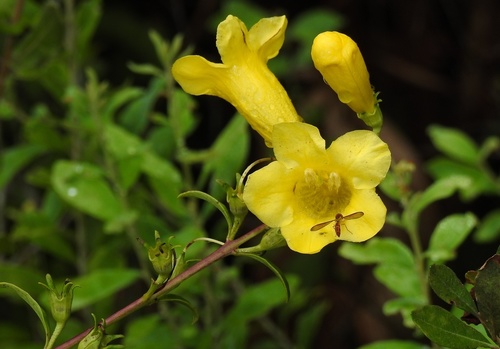
Aureolaria flava (L.) Farw. is a perennial, bisexual herb with arching, ascending, or erect growth habit. Stems typically reach 50–250 cm in length, are usually tinged purple or somewhat glaucous, consistently fistulose (hollow), and are characteristically mostly glabrous along with the leaves. It has a superior ovary. Its leaves are distinctly pinnatifid, commonly 6–15 cm long, with an acute apex; they are arranged oppositely or decussately, with entire margins. The upper (adaxial) leaf surface is deep green with a light covering of nonglandular puberulous hairs, while the lower (abaxial) surface is lighter green and glabrous. Bright yellow flowers bloom from June to September. The calyx is bell-shaped, 9–16 mm long, 5-lobed, glabrous, with linear lobes and entire margins. The corolla is also bell-shaped, 35–60 mm long, glabrous on the outside, and pubescent at the internal base and lobe margins. It has 4 stamens fused to the base of the corolla tube. Anthers are up to 7 mm long, spurred at the base, and surrounded by a dark green nectary ring. Its fruits are small ovoid capsules 12–20 mm long, which are often glabrous. Seeds measure 1.7–2.7 mm long and have coarse winglike ridges. While Aureolaria flava is often confused with other members of its genus, its glabrous stem is a very distinct feature that allows for easy differentiation. Aureolaria flava is hemiparasitic: it forms connections between its roots and the roots of its host plant using a specialized root structure called a haustorium. It produces its own energy via photosynthesis and has green tissue, so it is only partially parasitic, and the host provides water, additional sugars, and proteins to supplement A. flava's needs. It grows most commonly in hardwood forests, and specifically prefers oaks, especially white oaks. It also prefers well-drained soils, though it can still be found in a diverse range of habitats. As a weak parasite, it is suggested that Aureolaria flava causes little to no damage to large host trees, and may even help absorb some mineral nutrients for the trees. Aureolaria flava has a broad distribution across the eastern United States and Canada. It is listed as critically imperiled in the U.S. state of Delaware, and considered imperiled in the U.S. states of Pennsylvania and Vermont, as well as the Canadian province of Ontario. The concerning conservation status of A. flava in these regions is due to its reliance on semi-open oak ecosystems, which are under threat from a variety of factors across eastern North America that directly put Aureolaria flava at risk. Odocoileus virginianus, the white-tailed deer, also poses a significant threat to A. flava; continually growing deer populations have led to increased herbivory of many plant species, including this one.