About Aureoboletus russellii (Frost) G.Wu & Zhu L.Yang
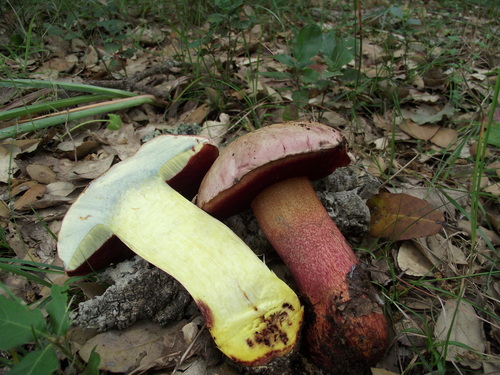
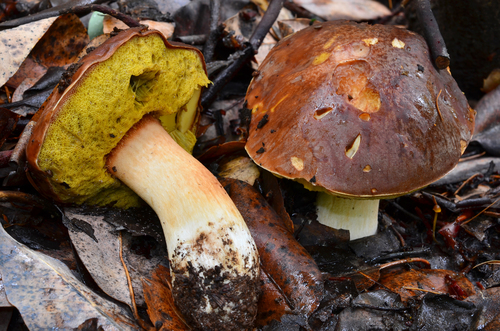
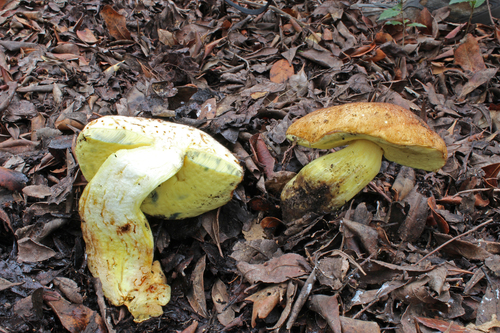
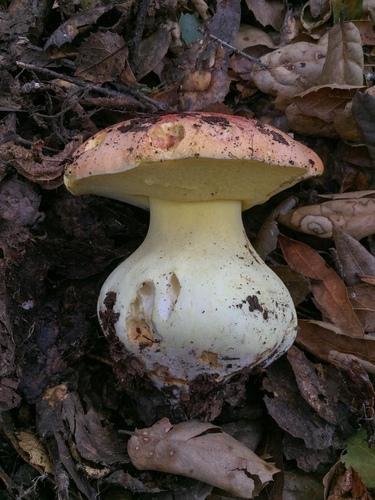
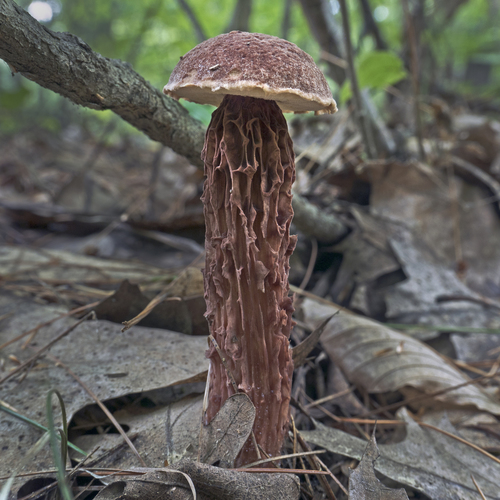
The cap of Aureoboletus russellii ranges from hemispheric to convex or broadly convex, growing to 3–13 cm (1+1⁄4–5 inches) in diameter. The cap surface is initially velvety with an inward-rolled margin; as it matures, the cap cracks to form scale-like patches. Cap color varies from yellow-brown to reddish-brown to olive-gray, and the flesh is pale yellow to yellow. The pore surface is yellow to greenish yellow, and turns a brighter yellow when rubbed or injured. The pores are angular, about 1 mm wide, and the pore-forming tubes reach up to 2 cm (3⁄4 inches) deep. The stem grows up to 20 cm (8 inches) long and 1–2 cm (3⁄8–3⁄4 inches) thick; it is usually roughly equal in width along its length, or slightly thicker at the base. Stem color is reddish brown to pinkish tan; the stem is solid (not hollow or filled with pith), sometimes curved, and viscid at the base. Its surface texture features deep grooves and ridges; the ridges are torn and branched, giving the stem a shaggy appearance. There is no partial veil or ring on the stem. The spore print of this species is olive brown. The spores are ellipsoid, measuring 15–20 by 7–11 μm. Similar to the stem's ridged texture, the spore surfaces have deep longitudinal grooves and furrows, and sometimes have a wall cleft at the top of the spore. Aureoboletus russellii occurs in eastern North America, where it grows singly or scattered on the ground in mycorrhizal association with oak, hemlock, and pine trees. Its geographic range extends from eastern Canada south to Central America, and west to Michigan and southern Arizona. It is also found in Asia, including Korea and Taiwan. The fruit bodies of Aureoboletus russellii are edible, but are not considered particularly desirable for cooking because their texture is soft and they have very little flavor.