About Aureoboletus projectellus (Murrill) Halling
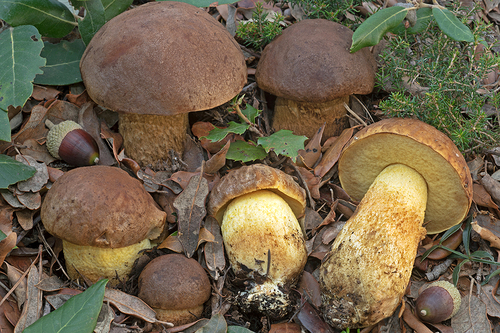
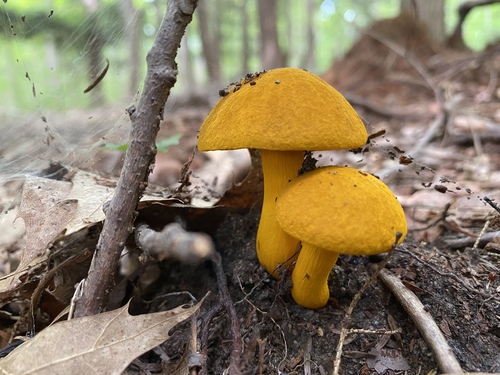
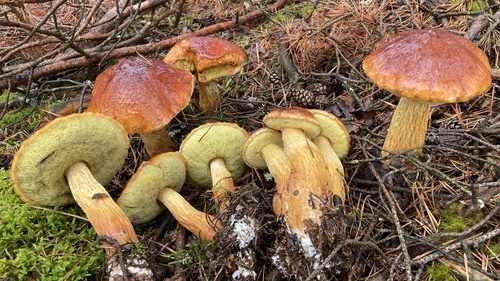
The cap of Aureoboletus projectellus starts convex, becomes flattened when mature, and reaches 4–20 cm (1.6–7.9 in) in diameter. The cap surface is dry; it initially has a velvety or slightly hairy texture, and develops small cracks as it ages. Young specimens have caps colored pale to dark cinnamon-brown, dull reddish, or dark reddish-brown, sometimes with gray or olive-green tints that are especially common in younger individuals. The flesh is whitish, sometimes with rosy tints, has no distinctive odor, and tastes acidic. Unlike many bolete species, the flesh does not turn blue when cut or injured, but it does slowly change to yellow-brown. The pore surface on the underside of the cap is yellow when young and turns brownish-olive at maturity; the circular pores are 0.5–2 mm wide. The tubes that make up the hymenophore are 1–2.5 cm (0.4–1.0 in) deep. The stem measures 9–24 cm (3.5–9.4 in) long and 1–5 cm (0.4–2.0 in) thick, with a consistent width along its length or a wider base. It is solid (not hollow), dry, and matches the cap's color or is lighter. The stem surface has a prominent network-like reticulum, particularly on its upper two-thirds; near the base, it has a white fuzzy tomentum. The stem base becomes sticky in wet weather.
Aureoboletus projectellus produces an olive-brown spore print. Its spores are smooth, oval to spindle-shaped, and measure 18–33 by 7.5–12 μm; these are the largest spores of any bolete species native to North America. Fruit bodies of this species are edible, and can be fried without requiring pre-boiling. They can be used in mushroom dyeing to produce yellow, brownish orange, dark orange, greenish brown, or greenish yellow, depending on the mordant used.
Fruit bodies grow singly, scattered, or in groups on the ground, forming mycorrhizal associations with pine trees. In North America, its range extends from eastern Canada (New Brunswick) south to North Carolina and west to Michigan, and it has also been recorded in Mexico. The species was first reported in Europe in 2011, found on Lithuania's Curonian Spit, with identification confirmed by comparing DNA sequences to verified North American collections. It was reported from Latvia in 2013, where it was named "fungus of the year 2014". It has been recorded in Poland since 2016, Norway and Denmark since 2014, Sweden since 2017, and is widely distributed in Estonia. It was first reported in Finland in 2023.