About Aureoboletus mirabilis (Murrill) Halling
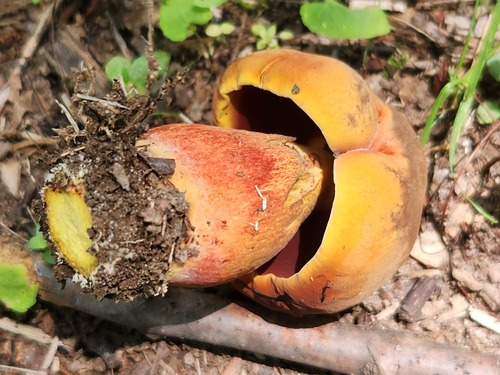
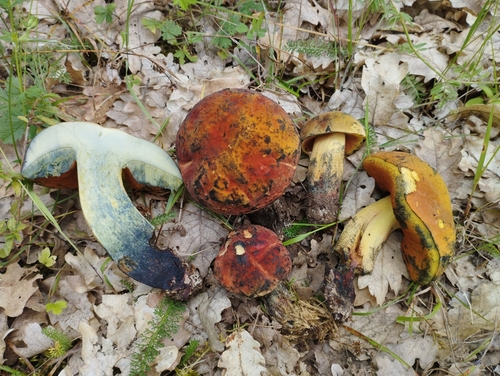
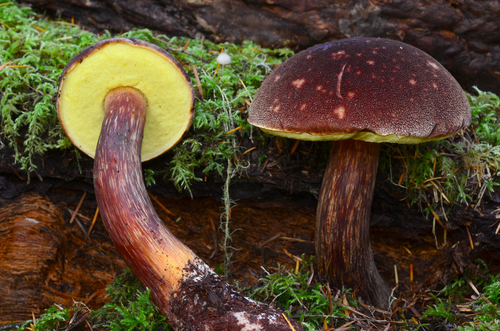
This fungal species, Aureoboletus mirabilis (Murrill) Halling, produces fruit bodies with caps that reach up to 15 cm (6 in) in diameter. Caps are red or brownish-red, starting convex before flattening out as they mature. The caps are fleshy, with a rough surface that is slippery or slimy on young specimens or in moist environments, while older specimens typically have dry, velvety cap surfaces. The rough cap texture develops from appressed (flattened-down) fibrils early on, and later forms recurved (bent-back) scales, or sometimes cracked rough patches that look like dried cracked mud. Young specimens may have a small flap of thin tissue at the cap margin, which is a remnant of a reduced partial veil. The cap surface is covered in tufts of soft woolly hairs, and has persistent papillae. The tubes located underneath the cap grow up to 2.5 cm (1 in) long; they start pale yellowish, and turn greenish-yellow with age, or mustard-yellow if injured. The pores have diameters of 1–2 mm. The cap flesh can be pale pink, yellow, or white, sometimes with blue hints, and is usually red just beneath the cap surface. The flesh is firm but watery, thick, and either does not change color or becomes deeper yellow when bruised. At the junction of the stem and cap, the flesh measures 1 to 1.5 cm (3⁄8 to 5⁄8 in) thick. The stem grows up to 18 cm (7 in) long; it is usually thickest at the base, tapers upward, and reaches up to 4 cm (1+5⁄8 in) thick at the base and 0.5 to 1 cm (1⁄4 to 3⁄8 in) thick at the apex. It typically starts with a bulbous shape, but becomes more uniform in width from base to apex as it matures. The stem surface is dry, often roughened and pitted, with a network of grooves or ridges (striations) or reticulations near the top of the stem. It is roughly the same color as the cap, and bruises to a darker reddish-brown near the base. The stem is solid (not hollow), with pale purplish flesh at the top and yellowish flesh below. The mycelium at the base of the stem is also yellow. When spores are collected in a spore deposit, they appear olive-brown. Under a microscope, spores are spindle-shaped to roughly elliptical, with smooth, thick walls, and measure 18–22 by 7–9 μm. Overholts' 1940 publication on this species reported spore dimensions of 20–26 by 8–9 μm. The basidia (spore-bearing cells) are club-shaped, hyaline (translucent), 4-spored, and measure 31–36 by 7–11 μm. Cystidia (sterile cells on the pore surface) are thin-walled, and measure 60–90 by 10–18 μm. No clamp connections are present in the hyphae. Fruit bodies grow solitarily, scattered, or sometimes in small groups, on the ground or on well-decayed conifer logs, especially logs of western and mountain hemlock, and occasionally logs of Douglas-fir and western red cedar. The fungus is strongly suspected to form mycorrhizal associations with hemlock, though standard attempts to grow A. mirabilis mycorrhizae in laboratory culture have failed. Although fruit bodies are sometimes found growing on logs with advanced brown cubical rot — a trait suggestive of cellulose-decomposing saprobic fungi — the rotten wood that hosts the fungus typically contains abundant conifer roots. It has been suggested that A. mirabilis has specifically adapted to this niche to reduce competition for nutrients with other mycorrhizal fungi, and that its inability to be cultured as mycorrhizae in the lab using standard techniques may stem from a requirement for certain physical or chemical characteristics of wood affected by brown cubical rot for growth. Fruit bodies of Aureoboletus mirabilis usually appear from late summer to autumn. The species is distributed in hemlock forests of the Pacific Coast Ranges from Northern California to Alaska, the Cascade Range, and interior forests such as those in Manitoba. It has a disjunct distribution, and has also been collected in Japan and Taiwan. Aureoboletus mirabilis is edible. Murrill described it as tasteless, and noted that "this is one of the most difficult species to preserve, owing to its extremely juicy consistency". In contrast, modern field guides classify this species as an excellent edible, with one source stating that only Boletus edulis surpasses its flavour. When sautéed in butter, the flesh has been recorded to have a lemony taste. Field specimens covered by the white mold Sepedonium ampullosporum should not be consumed. The mushroom may also be attacked by Hypomyces chrysospermus.