About Aureoboletus innixus (Frost) Halling, A.R.Bessette & Bessette
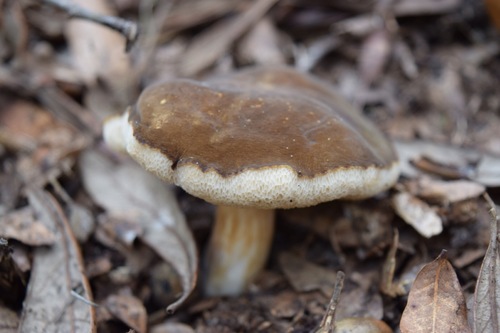
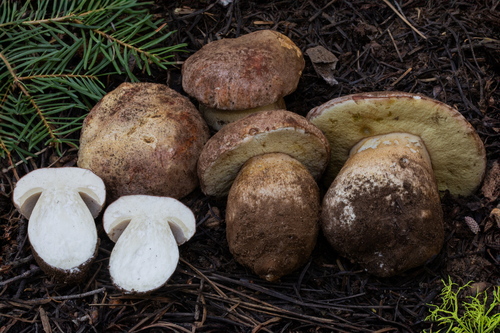
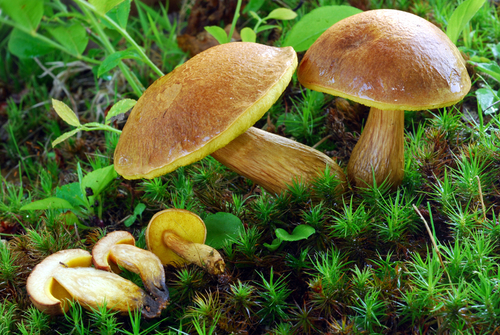
Aureoboletus innixus is a species of bolete fungus belonging to the family Boletaceae. This species is found in eastern North America. It was first described scientifically by Charles Christopher Frost in 1874, from collections made in New England. It is an edible mushroom. Its convex cap grows to 3–8 cm (1.2–3.1 in) wide, and has a color ranging from dull reddish brown to yellow brown. The stem is 3–6 cm (1.2–2.4 in) long and 1–1.6 cm (0.4–0.6 in) thick, and it is often swollen at the apex with a tapered base. When young, this fungus has a bright yellow pore surface that dulls in color as it matures. When young, there are approximately 1 to 3 pores per mm; as the fungus matures, pores expand to reach about 2 mm wide. The spore print of Aureoboletus innixus is olive-brown. Its spores are ellipsoid, smooth, and measure 8–11 by 3–5 micrometers. This mushroom is often confused with the similar, also edible, species Aureoboletus auriporus, which has a cap that ranges in color from pinkish cinnamon to dark reddish brown.