About Aureoboletus auriflammeus (Berk. & M.A.Curtis) G.Wu & Zhu L.Yang
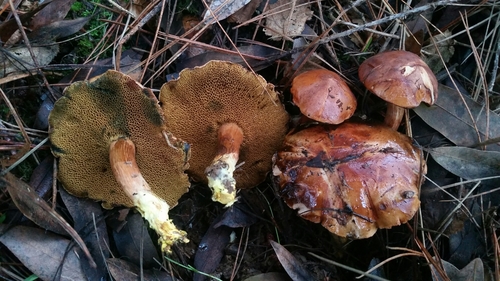
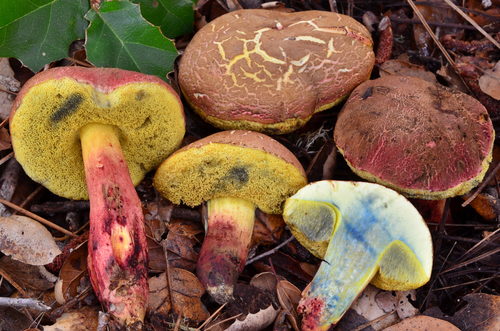
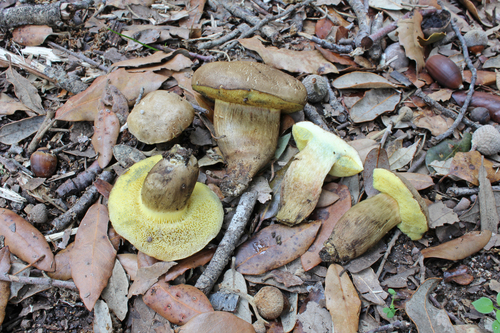
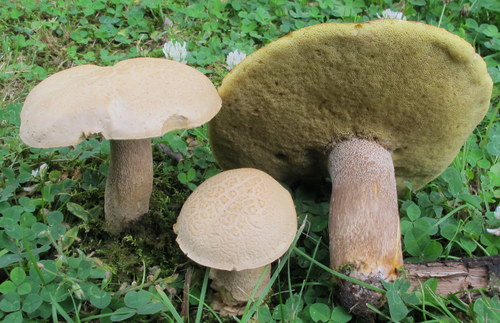
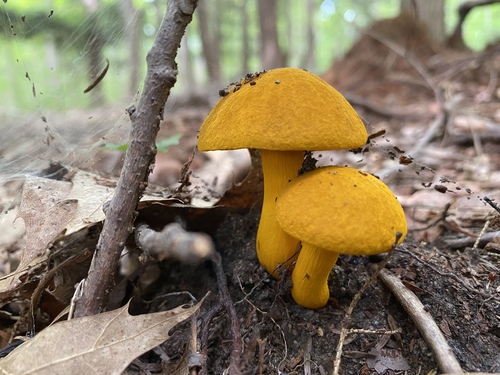
The cap of Aureoboletus auriflammeus starts convex, becoming broadly convex to flattened as it ages, reaching a diameter of 3–9.5 cm (1.2–3.7 in). The cap surface is dry; young specimens have a powdery coating that will stain hands yellow when handled. As it matures, the cap becomes tomentose (hairy), and sometimes develops small cracks. Its color is bright orange-yellow, sometimes mixed with olive tints. The flesh is white to cream, and does not turn blue when bruised, injured, or exposed to air after cutting. The mushroom has no distinctive odor, and its taste is either not distinctive or acidic. The pore surface begins yellow to yellow-orange, turning olive-yellow to greenish yellow with age, and sometimes develops bright crimson to crimson-orange tints. Tubes attach to the stem in an adnate to subdecurrent pattern (running slightly down the stem length) and are often depressed near the stem when mature. The pores are angular, radially elongated close to the stem, and are typically more than 1 mm wide at maturity. Tubes grow up to 1.5 cm (0.6 in) deep. The stem is 5–9 cm (2.0–3.5 in) long, 5–12 mm (0.20–0.47 in) thick, and is either roughly equal in width along its length, or slightly enlarged at either end. The stem surface is usually reticulate at least on the upper portion of mature specimens; this feature is less pronounced or absent in young individuals. The mycelium at the stem base is white. The stem has neither a partial veil nor an annulus. Aureoboletus auriflammeus produces an olive-brown to ochre-brown spore print. It is unknown whether its fruit bodies are edible. Spores are roughly elliptical to somewhat spindle-shaped, smooth, nearly hyaline (translucent), and measure 8–12 by 3–5 μm. Cheilocystidia (cystidia found on the tube edges) are abundant, thin-walled, and broadly club-shaped to sphaeropedunculate (rounded with a short stalk). Pleurocystidia (cystidia found on the tube faces) are abundant, thick-walled, broadly ventricose (swollen in the middle) or sometimes club-shaped. The cap cuticle is composed of hyphae that have bright yellow encrusted crystals in water; these crystals dissolve in potassium hydroxide to produce a diffuse lemon-yellow pigment. Fruit bodies of Aureoboletus auriflammeus grow singly, scattered, or in groups on the ground in woods, forming mycorrhizal associations with oaks. Its fruiting season runs from July to November. It is an occasional species, with a range extending from New York south to Florida, and west to Ohio and Tennessee.