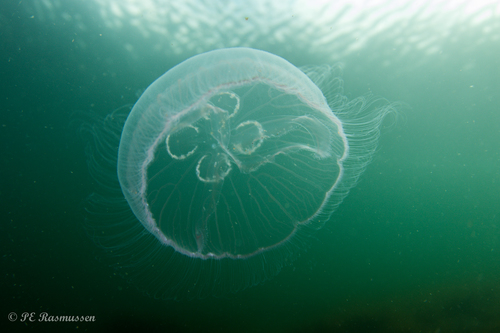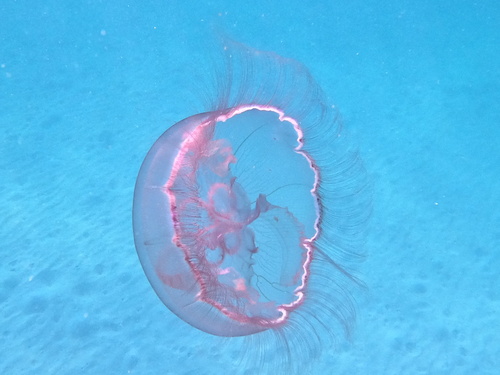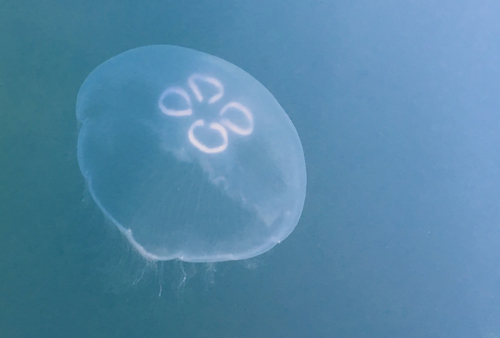
About Aurelia coerulea von Lendenfeld, 1884
Aurelia coerulea, commonly known as the Asian moon jelly, is a species of moon jelly belonging to the genus Aurelia. This species is native to the seas off Japan, China, Korea, and California, as well as the Mediterranean and other temperate seas, and is also found in the coastal areas of these same regions. It is especially abundant in artificial habitats and sheltered regions. It has a very high reproductive rate that can lead to jellyfish blooming events. Blooms of A. coerulea cause problems such as damaging fishing operations, clogging nuclear power plant intakes, and disrupting local zooplankton populations. Chemical compounds secreted by this species as part of its self-defense mechanism can be used for pharmaceutical purposes. A. coerulea mainly settles and proliferates in culture ponds, artificial reefs, lagoons, marinas, and other cold, shady artificial structures. As weak swimmers, these structures protect the species' polyps from being washed away. While hypoxia in coastal waters causes stress and disrupts the life cycles of most benthic organisms, A. coerulea polyps are more tolerant of low dissolved oxygen levels than many of their competitors. This allows their population to increase as other species are driven away by hypoxic stress. A. coerulea prefers moderate ambient temperatures; unstable temperatures and non-typical salinity have harmful effects on the species. A. coerulea can undergo two different life cycles, the metagenetic life cycle and the direct development life cycle, and can alternate between these strategies depending on environmental conditions. In the metagenetic life cycle, A. coerulea planula develop into polyps that attach to substrates for up to six months before strobilation. Under warm conditions, polyps reproduce asexually, while under cold conditions, polyps grow and then strobilate. Drawbacks of this life cycle include that polyps must compete for space and avoid predation. In the direct development life cycle, A. coerulea planula develop directly into ephyra. The ephyra stage has longer longevity and a higher chance of finding suitable substrates to settle. While this stage has lower mortality, its population growth rate is slower than that of the metagenetic life cycle. A. coerulea lives in bacteria-rich habitats, and secretes a phenolic compound that is known to have natural antioxidant properties. It has also been reported that the oral arms, umbrella tissues, and mucus of A. coerulea show lysozyme-like activity. These unique mechanisms contribute to the species' self-defense system against bacteria. Extraction of these useful compounds can be applied to biotechnological and pharmaceutical purposes.