About Aulostomus strigosus Wheeler, 1955
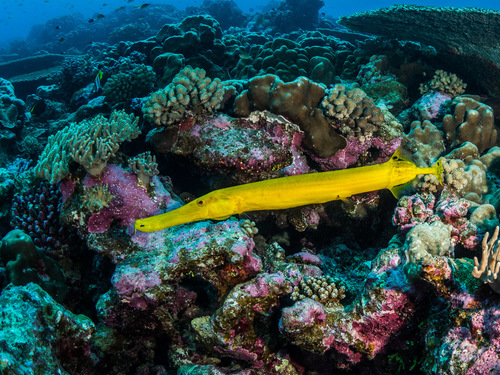
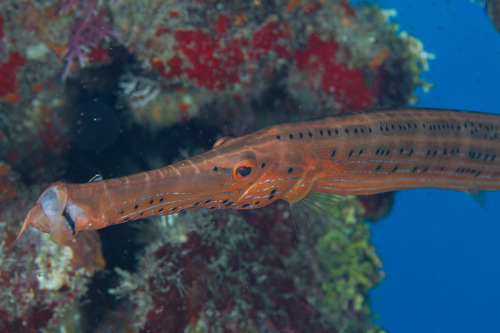
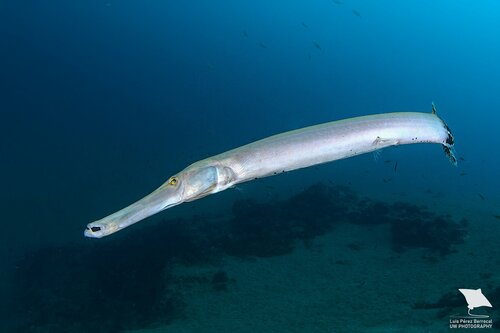
Aulostomus strigosus, commonly called the Atlantic trumpetfish, is a species of trumpetfish. Like other trumpetfish, it has a long body with an upward-facing mouth at the end of a long tubular snout. This species can change its color, either to communicate excitement or for camouflage. The most commonly recorded colors are brown, blue, green, or orange tones, along with intermediate shades. It can display a pattern of pale vertical and/or horizontal lines, or dark mottling across its body. Its dorsal and anal fins are semitransparent, with a black dot positioned in front of each fin. Typically, it has four white spots on its body between the dorsal and anal fins, three white vertical lines on its long caudal peduncle, and a black submarginal dot on each margin of the caudal fin. The wide variety of coloration seen in trumpetfish is produced by chromatophores, pigment-containing cells. Blue body tones come from melanophores, which hold a type of melanin called eumelanin that generally absorbs light. The heads of blue individuals contain iridophores, light-reflecting particles that are less common in trumpetfish of other colors. The combination of light-absorbing melanin and light-reflecting iridophores creates this unique blue coloration. Other combinations of light-reactive pigment cells, including erythrophores and xanthophores, produce the different patterns seen on mottled individuals. Aulostomus strigosus can be confused with the West Atlantic trumpetfish Aulostomus maculatus due to their similar morphology and overlapping ranges. Unlike A. maculatus, A. strigosus has never been recorded to have the silvery streaked patterns common in A. maculatus. This species reaches a maximum total length of 75 cm. Aulostomus strigosus is a demersal coastal species that lives over rocky or coral substrates in inshore waters. A Mid-Atlantic barrier separates this eastern Atlantic species from the West Atlantic trumpetfish. It inhabits a large range, occurring in the warm waters of the eastern Atlantic from Namibia north to Mauritania, and is also found in the Macaronesian Islands including Madeira, the Cape Verde Islands, and the Canary Islands. The species has also been recorded in Espírito Santo and St. Paul's rocks in Brazil. While fish from this Brazilian location were originally classified as A. maculatus due to similar morphology, they have since been found to be genetically identical to A. strigosus. Aulostomus strigosus occurs at depths ranging from 5 m to 25 m. There is very little published information about the population dynamics of A. strigosus, and no focused surveys have been conducted for this species to date. The Atlantic trumpetfish is considered to be relatively uncommon, but it has a very strong population structure, unlike other trumpetfish species. Among all 106 amphi-Atlantic reef fish species, Aulostomus strigosus is one of only four that has migrated from the eastern Atlantic to the western Atlantic.