About Aulostomus maculatus Valenciennes, 1841
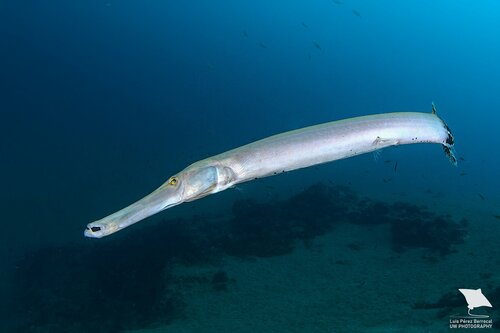
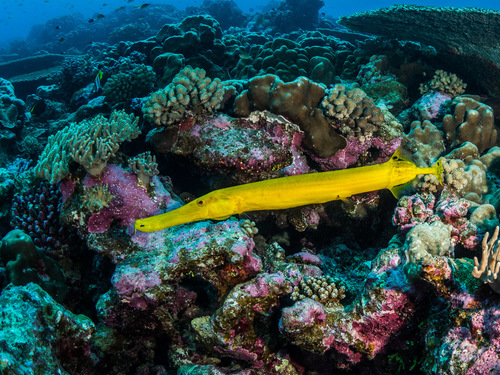
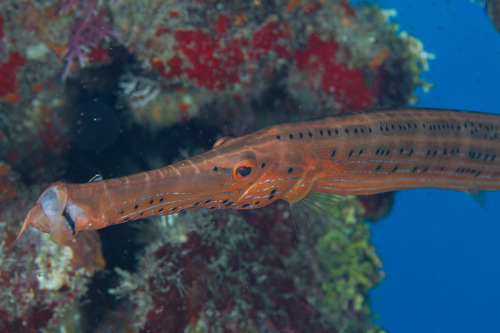
Aulostomus maculatus Valenciennes, 1841, commonly called trumpetfish, is closely related to cornetfish. This species has an average total length of 60 centimetres (24 inches), can reach just over 36 inches (91 centimetres), and has a maximum reported total length of 100 centimetres (39 inches). It has a greatly elongated, compressed body, with a compressed head featuring small jaws at the tip of its long, tubular snout. A distinct barbel sits on the chin, at the tip of the lower jaw. The dorsal and anal fins are positioned toward the posterior of the body. In front of the dorsal fin, there are 8-12 well-spaced, isolated spines; the dorsal fin itself has 12 spines and 12-25 soft rays. The anal fin has 21-25 soft rays, and the caudal fin is rounded. The most common coloration for this species is mottled brown to reddish brown, marked with irregular black or brown spots. Individuals may also be blue-gray, bright yellow, or green, and the species can change its color to camouflage itself. Transverse silvery streaks run across the head and flanks, and there is a black bar at the base of both the dorsal and anal fins, which is sometimes reduced to a spot. One or two spots may be present on the tail. Aulostomus maculatus is widespread across the tropical waters of the western Atlantic Ocean, ranging from Florida to Brazil, and including the Caribbean Sea and the Gulf of Mexico. Records of this species from the southernmost part of this range may actually refer to the related species Aulostomus strigosus. Trumpetfish is a largely piscivorous ambush predator. It hides among schools of large herbivorous fish, shadowing them until it gets close enough to strike at prey. It can also orient itself vertically among gorgonians or drift with the current, capturing any prey that swims beneath it. It sucks prey into its mouth, which contains elastic tissue that allows the mouth to open as wide as the diameter of the fish’s body. The sudden opening of the mouth creates a vacuum that pulls prey inside. Recorded prey includes the fish ocean surgeon (Acanthurus bahianus), blue chromis (Chromis cyanea), tomtate grunt (Haemon aurolineatum), French grunt (Haemulon flavolineatum), longspine squirrelfish (Holocentrus rufus), downy blenny (Labrisomus kalisherae), dusky blenny (Malacoctenus gilli), redlip blenny (Ophioblennius atlanticus), rusty reefgoby (Priolepis hipoliti), spotted goatfish (Pseudupeneus maculatus), reef squirrelfish (Sargocentron coruscum), yellowtip damselfish (Stegastes pictus), and Bluehead wrasse (Thalassoma bifasciatum), as well as shrimp. The damselfish Stegastes planifrons often aggressively attacks trumpetfish, but these attacks do not appear to interfere with the trumpetfish's hunting. Trumpetfish are normally solitary hunters, but they frequently associate with schools of striped parrotfish (Scarus iseri) to avoid attacks from S. planifrons. In these groups, trumpetfish have higher feeding rates than solitary individuals. Aulostomus maculatus is likely a minor component of the aquarium trade. It is often caught in seines and traps by fisheries, where it is considered to have only minor commercial interest.