About Aulacorhynchus sulcatus (Swainson, 1820)
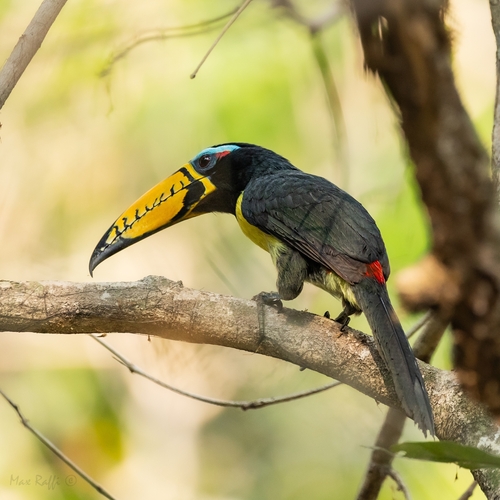
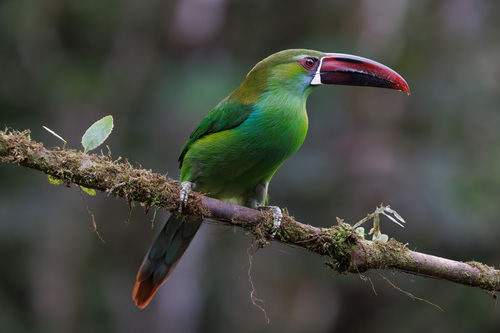
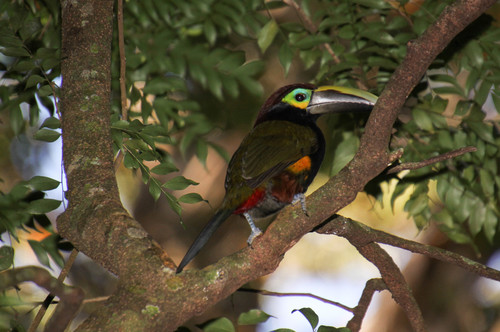
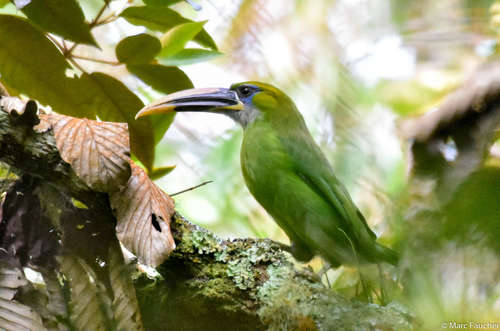
The groove-billed toucanet (Aulacorhynchus sulcatus) measures 33 to 37 cm (13 to 15 inches) in length and weighs 130 to 200 g (4.6 to 7.1 ounces). It gets its common English name from the grooves on its culmen and mandible. For the nominate subspecies and A. s. erythrognathus, most of the bill is wine-red to brown-red, with a diagonal black stripe on the mandible. The nominate subspecies also has a vertical white stripe at the base of its bill. For A. s. calorhynchus, the bill is mostly yellow with reduced black markings, some orange-red coloring at the base of the mandible, and a white stripe matching the one found on the nominate subspecies. All subspecies of the groove-billed toucanet are mostly green overall, with lighter underparts and yellower undertail coverts. The nominate subspecies has a white throat, some gold-bronze coloring on the face, and bare blue skin surrounding its brownish eye. A. s. erythrognathus has essentially identical plumage to the nominate, but with less gold-bronze on the face. A. s. calorhynchus also has similar plumage to the nominate, but is larger than both the nominate and A. s. erythrognathus. The different subspecies of groove-billed toucanet have distinct ranges. A. s. sulcatus occurs in northern Venezuela, between the states of Falcón and Miranda. A. s. erythrognathus is found in the mountains of northeastern Venezuela. A. s. calorhynchus ranges from the Sierra Nevada de Santa Marta and Serranía del Perijá in northeastern Colombia eastward to Lara in northwestern Venezuela. This species primarily lives in humid montane forest, but it can also be found in semi-open landscapes including secondary forest, forest edges, nearby isolated trees, and gardens. It avoids large open areas. In terms of elevation, it mostly occurs between 900 and 2,000 m (3,000 and 6,600 ft), but can be found as low as sea level and as high as approximately 2,400 m (7,900 ft).