About Aulacorhynchus prasinus (Gould, 1833)
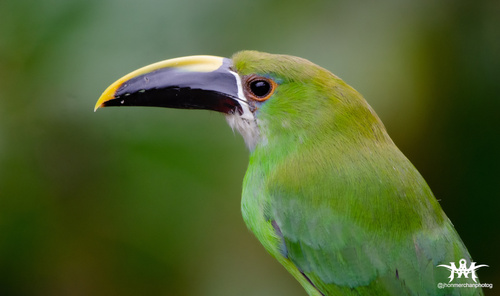
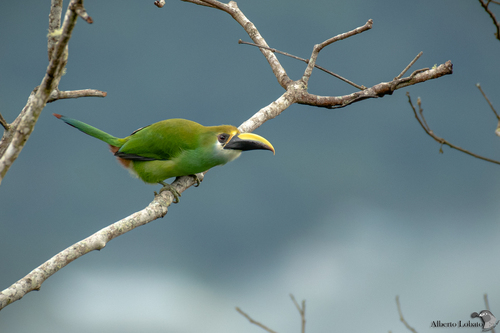
Like other toucans, the northern emerald toucanet (Aulacorhynchus prasinus) has bright markings and a large bill. Adult individuals are 29 to 37 cm (11 to 15 in) long, and weigh approximately 150 to 240 g (5.3 to 8.5 oz). The two sexes look similar, though females are generally smaller and have shorter bills. Their bill features a black lower mandible, a yellow upper maxilla with a black patch near the nostrils, and a white vertical stripe at the bill's base. Like other species in the genus Aulacorhynchus, all subspecies of this toucanet have mostly green plumage, which is lighter on the belly than on the upper body. The nominate subspecies has a bronze tinge on its crown, and a yellowy bronze tint on its nape and upper back. Its eye is dark brown, and is surrounded by darker bare skin. The lower face and throat are white. Flanks range from bright yellow-green to green-yellow, while undertail coverts and the underside of the tail are chestnut. The upper surface of the tail is green at the base, turning blue toward the tip, and the feather tips are chestnut. Subspecies differ primarily in throat color and bill characteristics. Subspecies A. p. warneri has a yellowish wash on its throat and some yellow on the face. A. p. virescens is slightly smaller than the nominate subspecies, with a yellower face and throat, more yellow on the flanks, and darker chestnut tips on its tail feathers. A. p. volcanius is similar to the nominate, but paler overall and slightly smaller. Immature birds are grayer than adults, and the chestnut color on their tail tips is browner and smaller. The northern emerald toucanet primarily lives in humid montane forest, but also occurs in more open landscapes including secondary forest, shrublands, pastures, and plantations. It occurs at elevations ranging from near sea level up to at least 3,000 m (9,800 ft), and it is non-migratory.