About Aulacorhynchus haematopygus (Gould, 1835)
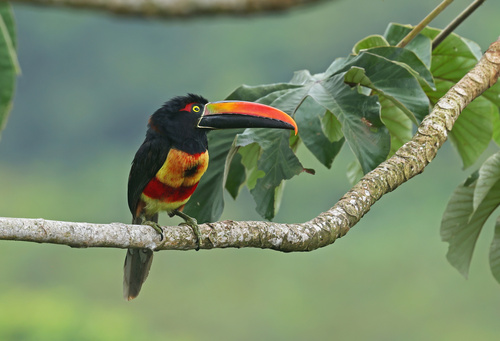
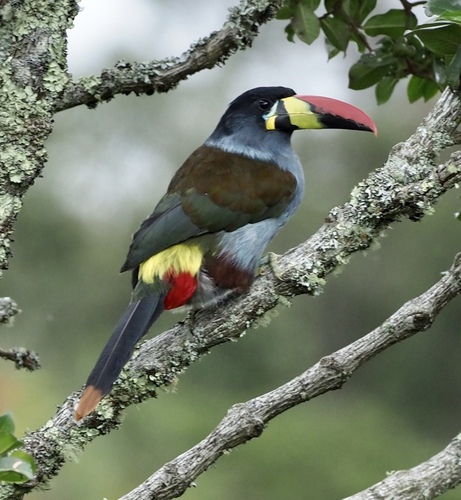
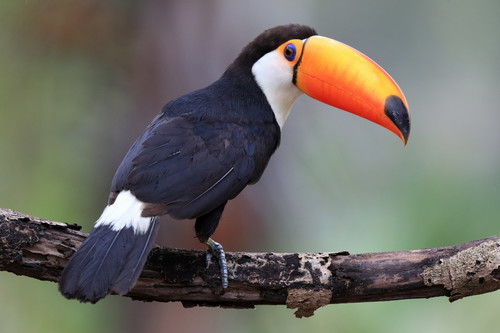
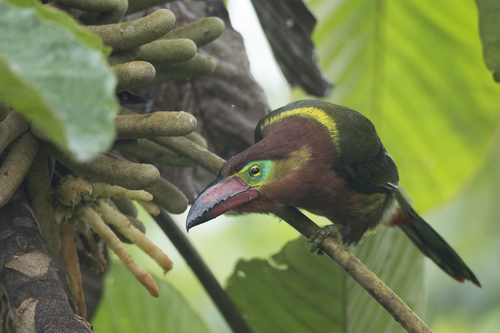
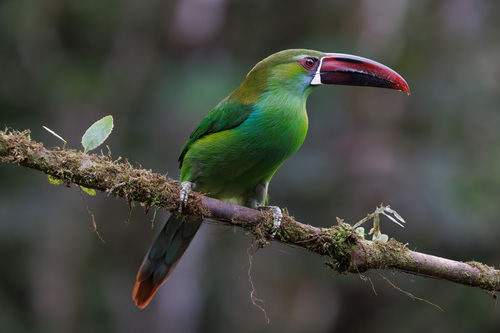
The crimson-rumped toucanet (Aulacorhynchus haematopygus) is 40 to 45 cm (16 to 18 in) long. The nominate subspecies weighs 200 to 232 g (7.1 to 8.2 oz), while the subspecies A. h. sexnotatus weighs 141 to 200 g (5.0 to 7.1 oz). The species' bill is brownish red and black with a vertical white line at its base, and the nominate subspecies has a larger proportion of black on its bill than A. h. sexnotatus. Males and females have identical plumage, but females have a shorter bill than males. Adults of both subspecies are mostly green, with a gold gloss on the nape and upper back, a red rump, chestnut tips on the central two or three pairs of tail feathers, and bare orange-brown skin around the dark eye. The nominate subspecies has blue coloring above and below the eye, and on the sides of the breast; A. h. sexnotatus has less blue in these areas. Immature birds are duller overall, with an orangey rump and a mostly reddish bill that lacks the white basal line. The nominate subspecies is distributed from western Venezuela's Serranía del Perijá, extending south along both slopes of the Andes through northern and central Colombia to southwestern Colombia. Its range may extend into northern Ecuador on the eastern slope of the Andes. A. h. sexnotatus is found on the western slope of Colombia's Western Andes in Nariño Department, and extends south to Loja Province in Ecuador. This species primarily lives in evergreen forest from the lowlands to the montane zone. It also occurs in semi-open landscapes including forest edges, secondary forest, and isolated fruiting trees growing in pastures and gardens. It mostly occurs at elevations between 300 and 2,200 m (980 and 7,200 ft), but has been found as high as 2,750 m (9,000 ft).