About Aulacomnium palustre (Hedw.) Schwägr.
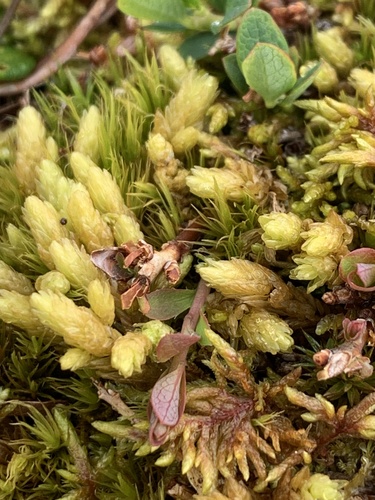
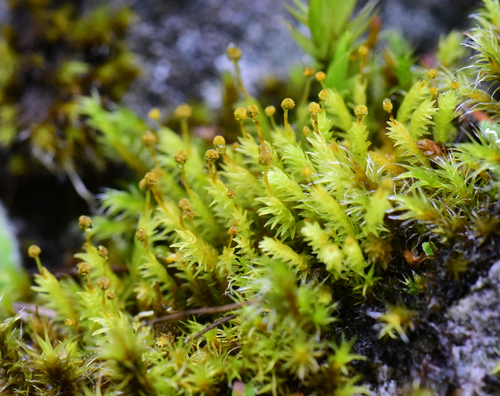
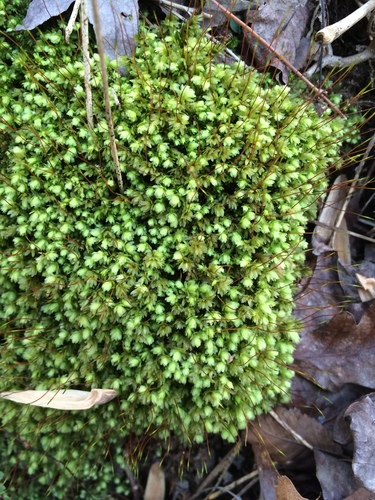
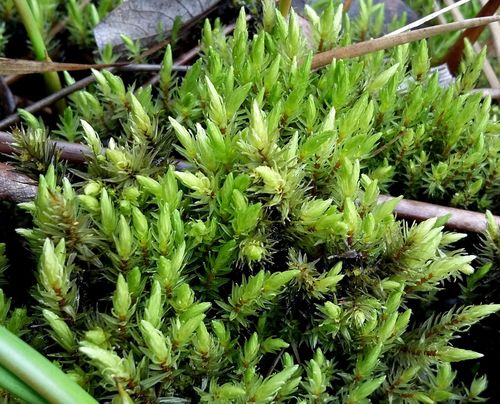
This species is Aulacomnium palustre (Hedw.) Schwägr., commonly called ribbed bog moss. Like all mosses, it has two morphologically distinct life cycle phases: the haploid (n) gametophyte generation and the diploid (2n) sporophyte generation. Ribbed bog moss is a habitat generalist. In one survey of bryophyte habitats on peatlands across Alberta's Mackenzie River basin, it was one of 6 moss species with broad ecological amplitude. It tolerates a wide range of moisture levels, substrates, nutrient loads, terrain, and climates. Ribbed bog moss is frequent in wetlands ranging from arctic to subboreal regions. Moss assemblages are typically diverse in northern (arctic, subarctic, and boreal) plant communities, and individual moss species often have low cover and/or frequency. In boreal communities, moss species with 2% to 4% coverage can be common to dominant, but ribbed bog moss can reach coverage as high as 40% in some boreal communities. It grows in both open and forested wetland communities. In unforested northern communities, ribbed bog moss occurs in sedge (Carex spp.) meadows, sphagnum (Sphagnum spp.) peatlands, heath-sedge fens, and willow (Salix spp.)-dominated fens. In forested areas, it grows in the ground layer of boreal and subboreal white spruce (Picea glauca), black spruce (P. mariana), mixed spruce-tamarack (Larix laricina), and jack pine (Pinus banksiana) fens and bogs located in Alaska, Minnesota, and Canada. It also grows in the ground layer of boreal spruce-birch (Betula spp.) forests of Alaska and northwestern Canada. Mosses are abundant in the taiga forests of interior Alaska and Canada, and form a characteristic stratum in nearly every type of taiga forest. Less information is available about ribbed bog moss community associations in regions south and east of Minnesota, though the species has been recorded in some swamps, coniferous and/or hardwood bogs, and grassland communities. It occurs in red maple (Acer rubrum) swamps of Long Island, New York, and has been listed as common (1-4% frequency) in Atlantic white-cedar (Chamaecyparis thyoides) swamps of southern New Jersey. It is also common in jack pine, aspen (Populus spp.), and mixed-hardwood forests of the Great Lakes states and southern Canada. It grows on tallgrass prairie in Kansas and Arkansas. In the Pacific Northwest, ribbed bog moss occurs in alpine, subalpine, wet and dry coniferous forest, and open peatland communities. In a survey of alpine and unforested subalpine communities of the North Cascade Range in Washington and British Columbia, ribbed bog moss was found in graminoid, forb, heath, and willow communities.