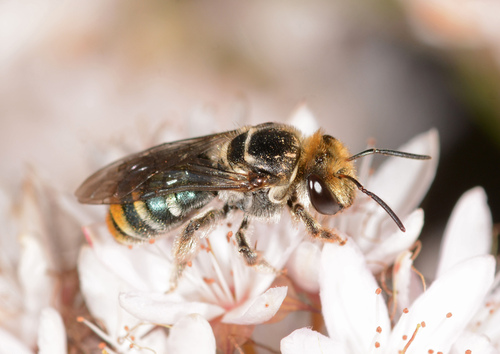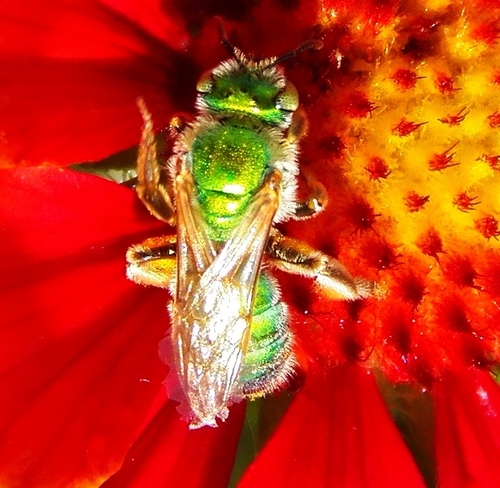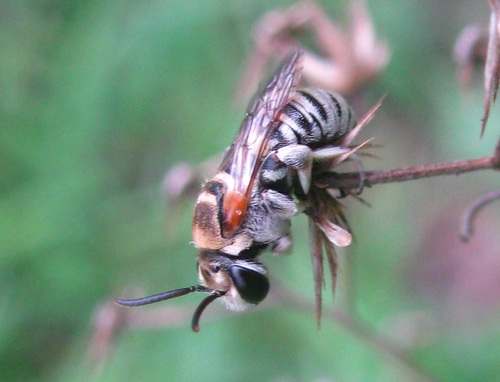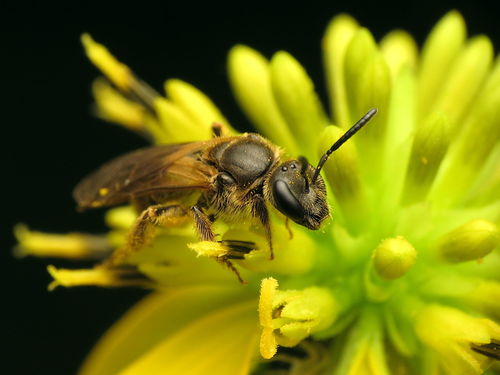
About Augochlorella aurata (Smith, 1853)
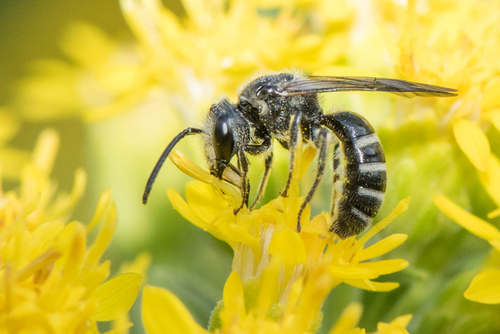
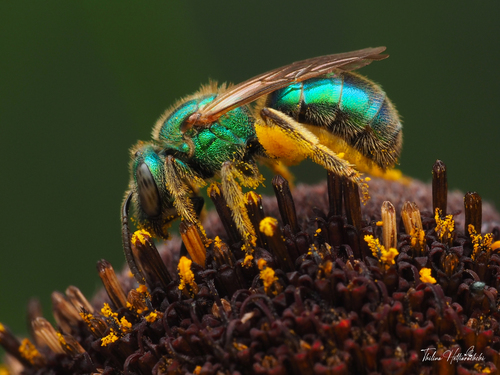
Augochlorella aurata individuals are typically golden green, but their body color can also range from metallic blue to coppery pink. Both males and females of this species measure around 5 to 7 millimeters in length, with females usually being slightly larger than males. Like many bees, A. aurata females have 10 antennal segments, while males have 11. A. aurata has several distinct characteristics that separate it from other similar-looking bees. Like most members of the Halictidae family, the tip of this species' mandible is rounded, shaped like a glove or mitten. This trait differentiates it from the closely similar species Augochlora pura, which has forked mandible tips. The propodeum of A. aurata is relatively uniform and lacks a ridge, which separates it from bees in the closely related genus Agapostemon. Its hind tibial spur is simple or slightly serrated, which distinguishes it from bees in the genus Augochloropsis. To separate Augochlorini bees from other Halictidae bees, female Augochlorini have a medial slit on their fifth abdominal segment (T5) that originates at the segment rim and extends at least a third of the segment's longitudinal length. Additionally, the marginal cell of A. aurata's forewing is pointed, while the marginal cell of A. pura is squared off. A. aurata is distributed across the United States, with populations concentrated along the east coast that spread westward. Its confirmed range extends from southern Canada south to Florida, and west to Colorado and Texas. Sparse occurrences of A. aurata have been recorded as far west as California and as far south as South America. Within the primarily Neotropical Augochlorini tribe, A. aurata has the northernmost distribution. Augochlorella aurata is a polylectic forager, meaning it collects pollen from many different plant species to use as food. Augochlorella species in general have been observed visiting a variety of horticulturally important crops, including apple, blueberry, cantaloupe, coffee, cranberry, pepper, tomato, and watermelon. A. aurata itself has been formally observed visiting tomato plants, Echinacea, and strawberry, though it likely visits many more plant species due to its generalist pollen feeding habit.