About Augochlora pura (Say, 1837)
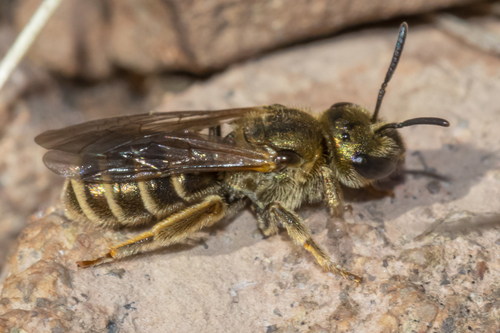
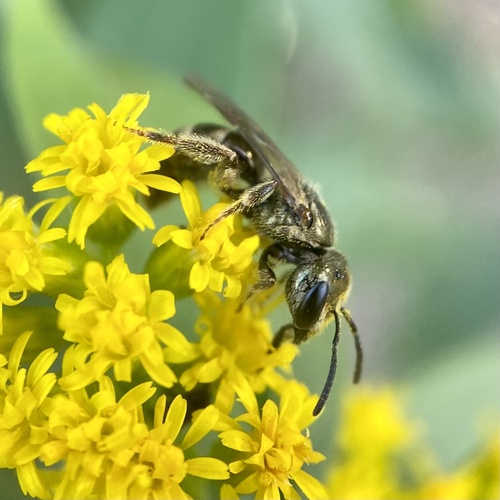
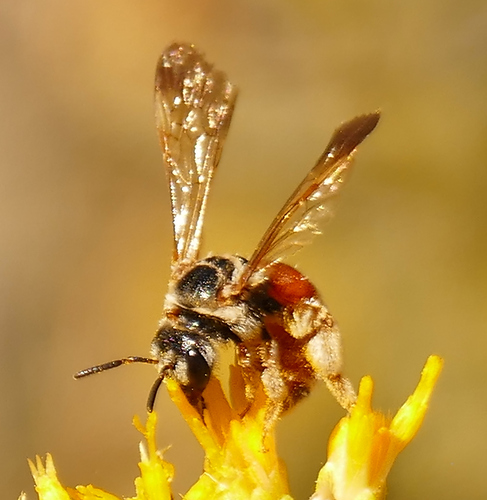
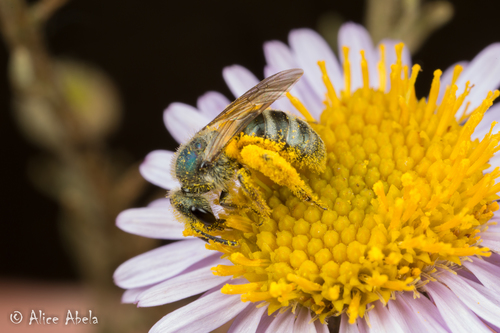
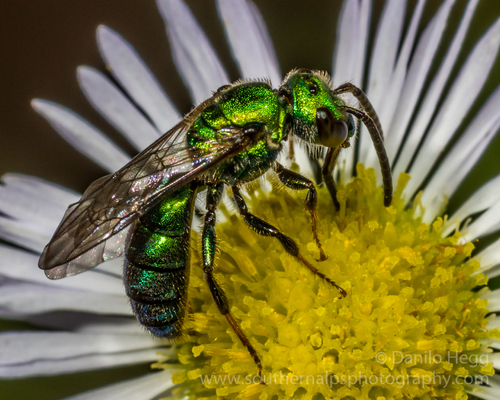
Description and identification: Both male and female Augochlora pura are approximately 8 millimeters in length. Across most of this species’ range, their entire bodies are shiny, bright green. This sets them apart from many Lasioglossum species, such as L. zephyrus, which are a dull metallic green. Males tend to have darker mandibles and may be slightly more bluish than females, but the two sexes are otherwise similar in appearance. Individuals found in Florida are a deep blue metallic color; this color form was previously classified as a separate taxon, Augochlora pura mosieri. Distribution and habitat: A. pura occurs primarily in the eastern United States, with a range extending from Maine through Minnesota, south through Texas and Florida. It has been recorded as far north as Quebec. Its active season runs from February through November, with longer active seasons in more southern states. This species builds nests in rotting wood found in forests, and will even nest in wood piles in suburban areas. It spends most of its time close to its nests, but also visits nearby brush and pastures. In a study of bottomland hardwood forests in the southeastern United States, A. pura made up approximately 91% of all bees collected in the area. Life cycle: The flight season of Augochlora pura runs from early April through September, though nests are only active from early May to early August. Unlike other halictids, A. pura does not become active and take flight on warm days that occur later in the fall. In natural conditions, this species produces two to three generations per year, limited by seasonal constraints. However, lab-reared A. pura have been observed to produce at least six generations per year, with no evidence that this cycle of generations would not continue indefinitely. In nature, females become active in August and September, mate, and enter ovarian diapause on moist soil underneath rotting logs. All males die in the fall. Overwintered females establish new nests in April. Their offspring emerge in June, and go on to found their own nests by the end of the month. Males typically emerge from the first brood cells constructed, with females emerging shortly after males. In laboratory settings, males live an average of 14.88 days.