About Augastes scutatus (Temminck, 1824)
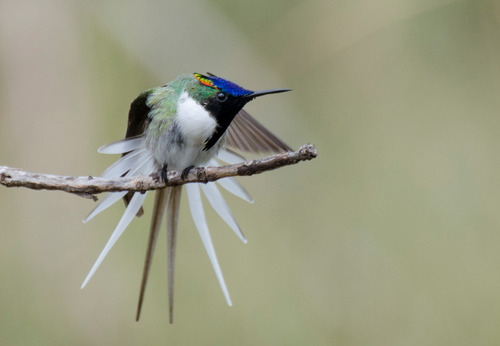
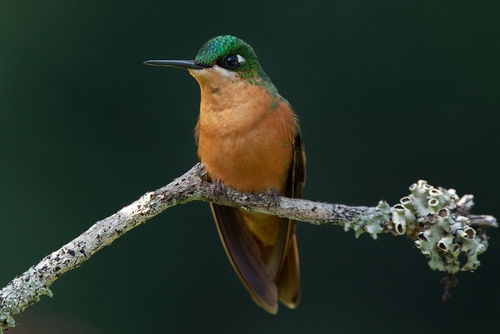
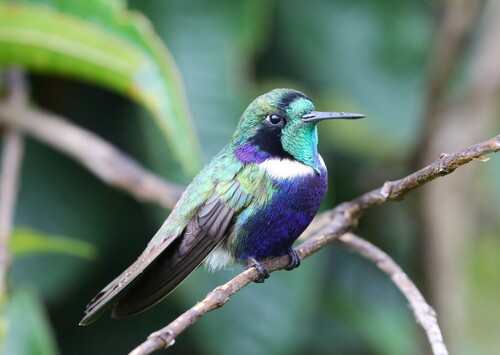
Augastes scutatus, commonly called the hyacinth visorbearer, has distinct physical size differences between males and females. Males measure 8.1 to 9.9 cm (3.2 to 3.9 in) in length and weigh 3 to 4 g (0.11 to 0.14 oz), while females measure 8 to 9.7 cm (3.1 to 3.8 in) in length and weigh 2.7 to 3.8 g (0.10 to 0.13 oz). In addition to being longer, heavier, and having longer wings and a longer tail than females, males also have a longer bill; both sexes have a short bill overall. The nominate subspecies of male has a shiny golden green forehead, with bronze-green bronze-green upperparts and tail. Its throat is also shiny golden green with a black edge, its belly is deep blue, and a creamy white to pink band runs across the chest between the throat and belly. It has a purplish blue "ruff" on the sides of the neck. Females do not have the black edge on the green throat; their blue belly is mottled with gray and blue-green, and their outer tail feathers are tipped with gray. Subspecies A. s. ilseae has dark violet ruffs, a violet-blue belly, and bluish green on the underside of the tail. Subspecies A. s. soaresi is the largest subspecies; it differs from the nominate only in having a blue line between the violet and green areas of the head. The hyacinth visorbearer is found only in the Brazilian state of Minas Gerais. The nominate subspecies occurs in central and eastern Minas Gerais, at elevations between roughly 1,000 and 2,000 m (3,300 to 6,600 ft), and typically inhabits dry rocky areas with low vegetation called campos rupestres. A. s. ilseae shares essentially the same overall range as the nominate, but occurs at elevations between roughly 900 and 1,200 m (3,000 and 3,900 ft), and is usually found in gallery forest and bushy areas. A. s. soaresi is restricted to the upper reaches of the Piracicaba River basin in south-central Minas Gerais, where it inhabits ravines in montane forest at elevations between roughly 1,000 and 1,600 m (3,300 to 5,200 ft).