About Aucuba japonica Thunb.
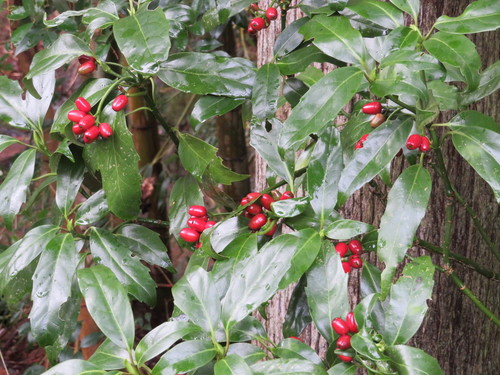
Aucuba japonica, commonly known as spotted laurel, Japanese laurel, Japanese aucuba, or gold dust plant (in the U.S.), is a shrub that grows 1 to 5 meters (3.3 to 16.4 feet) tall. It is native to rich forest soils of moist valleys, thickets, stream banks, and areas near shaded moist rocks in China, Korea, and Japan. This is the species of Aucuba most commonly grown in gardens, and it is often seen in variegated forms. Its leaves are arranged oppositely, are broadly lanceolate, and measure 5–8 cm (2.0–3.1 in) long by 2–5 cm (0.79–1.97 in) wide. Aucuba japonica is dioecious, meaning individual plants produce either male or female flowers. The flowers are small, 4–8 mm (0.16–0.31 in) in diameter, each with four purplish-brown petals. They grow in clusters of 10 to 30, arranged in loose cymes. The fruit is a red drupe approximately 1 cm (0.39 in) in diameter, which birds typically avoid. Golden variegation patterns in this species are inherited exclusively from the mother plant. If the female parent is variegated, all seedlings will be variegated no matter the appearance of the male parent. If the female parent has solid green foliage and the male parent is variegated, all seedlings will be green. This pattern suggests that variegation is not controlled by nuclear DNA, but instead is likely controlled by chloroplasts, the organelles where photosynthesis occurs. Chloroplasts reside in a cell’s cytoplasm, and are always inherited from the female parent. In cultivation, this plant is valued for its ability to grow well in the challenging garden condition of dry shade. It also tolerates pollution and salt-laden coastal winds. It is often grown as an informal hedge, and can also be kept indoors as a houseplant. Many cultivars are currently available from garden centers. The most popular cultivar is 'Variegata', which has yellow spots on its leaves and is a female clone; a similar male clone is named 'Maculata'. Three cultivars have earned the Royal Horticultural Society's Award of Garden Merit: 'Crotonifolia', 'Golden King', and 'Rozannie'. 'Rozannie' is a self-fertile variety that does not require a pollinator, and produces deep red berries against solid green, glossy foliage. Other existing cultivars include: forma longifolia 'Mr. Goldstrike', a male plant with leaves heavily speckled in yellow; 'Picturata', a female plant with yellow foliage edged in green; 'Petite Jade', a variety with narrower, slender, serrated solid green leaves that grows to 6 feet tall, and can reach 10 feet tall after 20 or more years; and 'February Star', a female plant with narrow leaves and sparse variegation spotting.