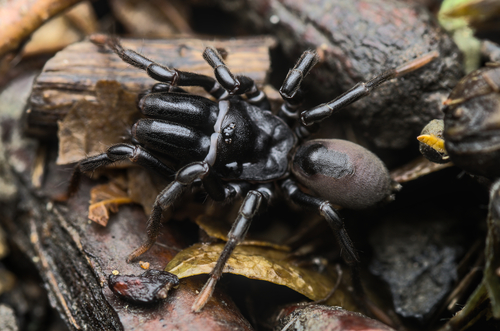
About Atypus affinis Eichwald, 1830
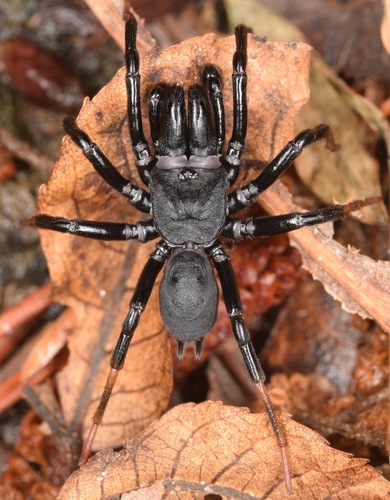
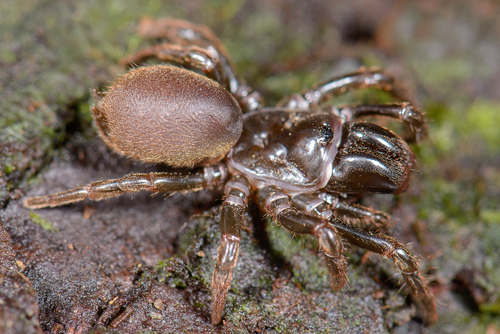
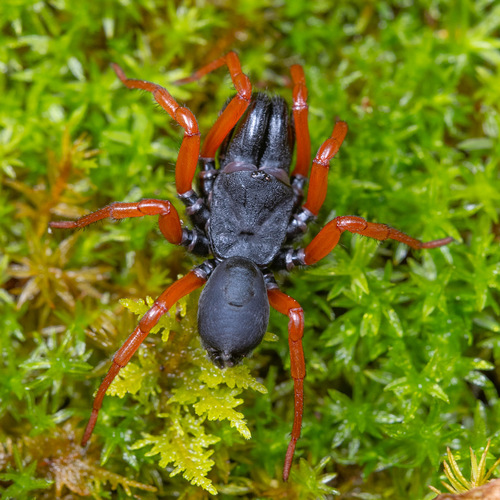
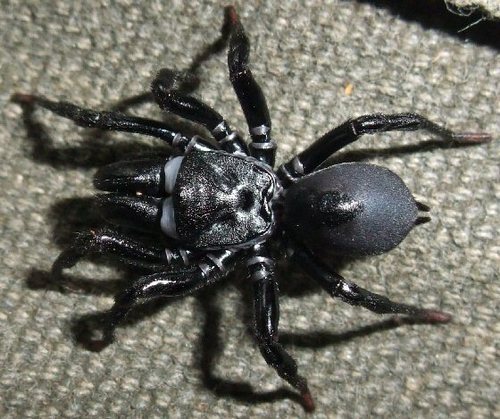
Description: Atypus affinis spiders are black or brownish, and are not particularly large. Males measure about 7–9 mm (0.28–0.35 in), while females are larger at 10–15 mm (0.39–0.59 in). They closely resemble Atypus piceus, but their spiderlings are often very lightly colored, and their three-part posterior spinnerets lack a light blot. Like other mygalomorph spiders, this species has fangs that point straight down rather than crossing. This spider spins an unusual web: it creates a silk tube partially hidden underground, with the above-ground portion covered in leaves and other debris. The spider waits for an insect to land or crawl onto the tube, then bites through the silk to pull the insect inside. These spiders usually do not leave their webs for any reason other than mating. They become sexually mature at about 4 years old. Mating season takes place in autumn, when male spiders seek out a female and enter her burrow, where the pair lives together until the male dies soon after mating. The female lays her egg sac inside the tube, and spiderlings hatch the following summer, then remain with their mother for nearly another year after hatching. Distribution: A. affinis is found across most of mainland Europe, in Great Britain, and in North Africa. This fossorial spider typically lives in dry heathland, open pine forest, meadows, grassland, and at the base of rocky outcrops. It is the only mygalomorph spider found in the Nordics and the United Kingdom, but this warm-preferring species is uncommon and localized in both these regions at the northern edge of its range. In the Nordics, it only occurs on south-facing slopes in the southern part: it is highly local but fairly widespread in Denmark, and highly local in southern Sweden (Blekinge and Scania). In the United Kingdom, where the species is localized and has experienced population decline, most records come from southern England, but it also ranges into Wales and north to far southwestern Scotland. It was formerly recorded from Ireland, based on the discovery of a single tubular webbing of the species in 1896. Today this record is considered most likely to come from a plant nursery import, and the species is no longer recognized as occurring on the island. Due to its hidden lifestyle, it is easily overlooked, though adult males can be seen wandering for a short period when searching for females and may be caught in pitfall traps. A. affinis tends to form colonies, where spiders can occur at high densities. Because of its low dispersal ability, even colonies that are only a few kilometers apart are often quite isolated from one another.