About Attila spadiceus (Gmelin, 1789)
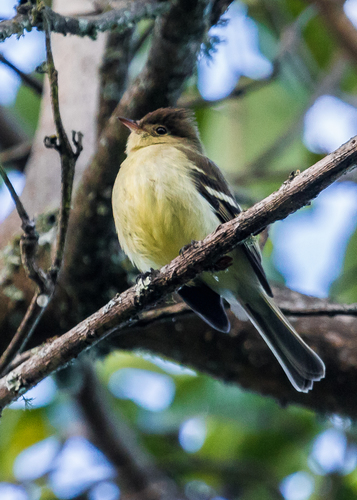
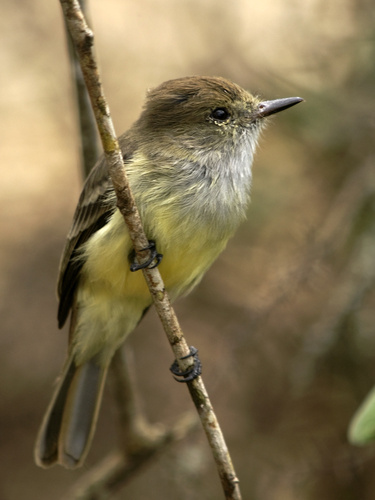
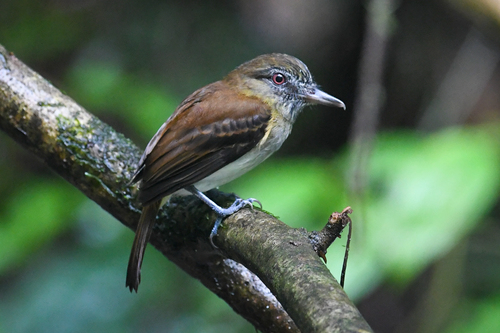
The bright-rumped attila, with the scientific name Attila spadiceus (Gmelin, 1789), is a large tyrant flycatcher that has a big head, a hooked and slightly upturned bill, and an upright stance. It measures 7 inches (18 cm) in length and weighs 1.4 oz (40 g). Its head is olive-green streaked with black, its back is chestnut or olive, its rump is bright yellow, and its tail is brown. The wings are dark brown, with two pale wing bars and paler feather edging. The throat is whitish or yellow, and the breast is yellow, both variably streaked with darker coloring. The belly is white, becoming yellow closer to the tail. This species has a red iris, and the sexes are similar in appearance. Young bright-rumped attilas have a cinnamon-fringed crown and brown eyes. The species' plumage is highly variable, but underpart streaking and clear wing bars help distinguish it from other species in its genus. Its calls include a loud "beat-it, beat-it" and a plaintive "ooo weery weery weery weery woo". It does not move while singing, which makes it difficult to spot. Populations in Central America have slightly different song structures and tend to have lighter ochre plumage independent of Gloger's Rule. These populations are sometimes separated as a distinct species, the flammulated attila (Attila flammulatus). The characteristic dawn song of these Central American birds has been analyzed in detail: it has a highly variable number of "weery" notes that may become "weery'o", and often ends in a "woo-whit". A finite-state machine has been developed to simulate the structure of this dawn song. Despite this technically plausible proposed split, the high variability of the songs means more data is needed before the split can be widely accepted, and the AOU has so far not formally acknowledged the separation. In terms of distribution and habitat, the bright-rumped attila is a common bird found from lowlands up to 7,000 ft (2,100 m) above sea level. It lives in forests, second growth, pasture and plantations with scattered trees, and shady gardens, and it appears able to tolerate a considerable amount of habitat destruction.