About Attila cinnamomeus (Gmelin, 1789)
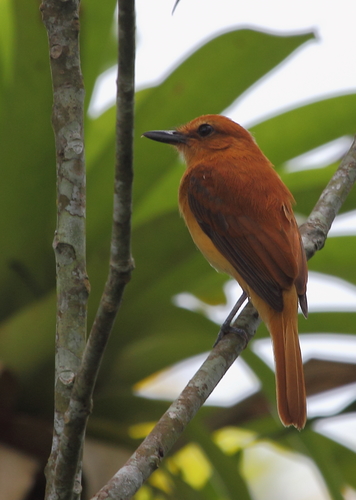
The cinnamon attila, scientifically named Attila cinnamomea (Gmelin, 1789), measures about 19.5 to 20.5 cm (7.7 to 8.1 in) long and weighs 28 to 45 g (0.99 to 1.6 oz). Males and females have identical plumage. Adult individuals have deep rufous coloring on the head, upperparts, and tail. Their wings are mostly deep rufous, with blackish primary flight feathers. Their wing coverts are dusky, with wide rufous edges. Their underparts are mostly cinnamon-rufous, with a belly that is somewhat yellower. They have reddish brown irises, a black bill, and gray legs and feet.
The cinnamon attila is native to the Amazon and Orinoco basins. Its range stretches from the southeastern third of Colombia south through eastern Ecuador into northeastern Peru, and continues east into Venezuela's Táchira and Amazonas states. In Venezuela, the range resumes in the northeast and extends from there across the Guianas. From southern Colombia, Ecuador, and Peru, its range extends across northern Bolivia and across Brazil to the Atlantic coast, with its southern boundary roughly following the line from Rondônia northeast to Maranhão.
The cinnamon attila lives in a variety of landscapes, most of which are closely associated with water. These habitats include várzea, igapó, and other swampy forests; oxbow lake edges; areas alongside small streams; river islands; and palm groves and mangroves in river deltas. In terms of elevation, it occurs from sea level up to 500 m (1,600 ft) in Brazil, up to 500 m (1,600 ft) in Colombia, up to 300 m (1,000 ft) in Ecuador, and up to 400 m (1,300 ft) in Venezuela.