About Attila bolivianus Lafresnaye, 1848
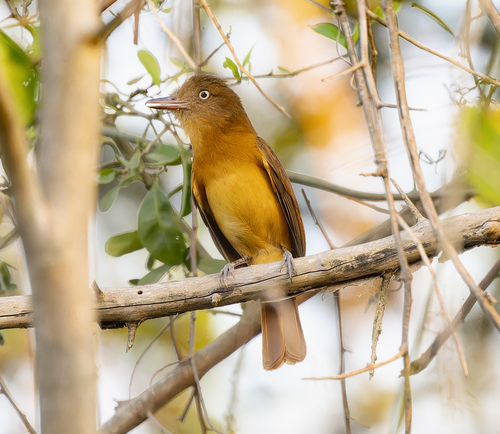
White-eyed attila (Attila bolivianus Lafresnaye, 1848) is 19 to 22 cm (7.5 to 8.7 in) long and weighs 40 to 45 g (1.4 to 1.6 oz). Males and females have identical plumage. Adults of the nominate subspecies have a grayish rufous-brown head. Their upperparts are mostly rufous-brown, with a bright cinnamon-rufous rump and tail. Their wings are mostly rufous-brown, with blackish greater coverts and primaries. Their chin has a faint grayish tint. Their throat and underparts are mostly cinnamon-rufous, with paler coloration on the belly. Subspecies A. b. nattereri is darker overall than the nominate subspecies, and has a sepia-tinged crown. Both subspecies have a pale yellowish white iris, a horn-colored maxilla, a pinkish-tinged horn-colored mandible, and blue-gray legs and feet. There are two subspecies, with A. b. nattereri distributed further north than the nominate. A. b. nattereri ranges from extreme southeastern Colombia south into the Department of Loreto in northeastern Peru, and extends east through Brazil along the Amazon almost to the Atlantic Ocean. The nominate subspecies ranges from Loreto in Peru south into northern and eastern Bolivia, and east into southwestern Brazil as far as southwestern Mato Grosso. While some sources note A. b. nattereri as present in Ecuador, the South American Classification Committee of the American Ornithological Society has no documented records of the species from that country. The white-eyed attila lives in riverine landscapes. In the Amazon Basin, it occurs in várzea and other swampy forests, most often on river banks and river islands. Further south in the Pantanal, it inhabits gallery forest. It can be found up to an elevation of 150 m (500 ft) in Colombia, and up to 500 m (1,600 ft) in Brazil.