About Atticora fasciata (Gmelin, 1789)
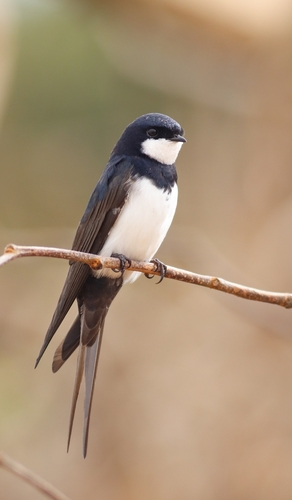
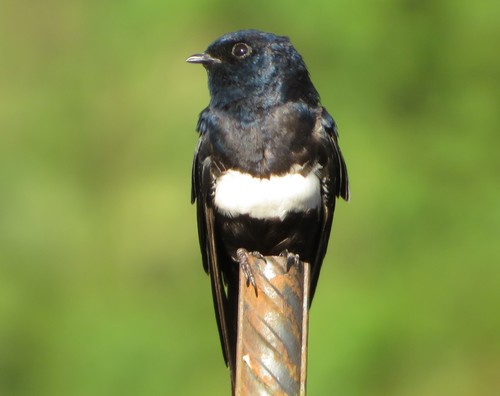
The white-banded swallow, with the scientific name Atticora fasciata (Gmelin, 1789), is a medium-sized swallow. On average, it measures 15 cm (5.9 in) long, weighs 12–16 g (0.42–0.56 oz), and has a wingspan of 92–108 mm (3.6–4.3 in). Body size gradually decreases from north to south across its range, and this gradual change suggests there is no distinct geographical variation in the species. Its plumage is mostly black, with white markings on its breast band, thighs, and bars along the edges of its wings. It has blackish-brown underwing coverts, and its feathers carry a blue-black luster. This species has a deeply forked tail. The sexes have similar appearance, though females are slightly heavier on average: males weigh 12–14 g (0.42–0.49 oz), while females weigh 12.8–15.8 g (0.45–0.56 oz). Juvenile white-banded swallows are duller and browner than adults, with shorter, paler feathers. This species can be distinguished from the similar black-collared swallow, which has white underparts and a white throat. The white-banded swallow's call is described as ti-ti-tur; it also produces a buzzy z-z-z-z-ee-eep call that is usually given during flight. This bird is native to Bolivia, Brazil, Colombia, Ecuador, French Guiana, Guyana, Peru, Suriname, and Venezuela. It nests in tropical lowland evergreen forests near water, alongside both blackwater and whitewater rivers in forested areas. In Colombia and Venezuela, it is found more frequently near blackwater rivers, where it nests on rocky outcrops. Despite occurring near water, it is rarely seen over lakes. It is sometimes spotted over forested clearings. It usually does not live at elevations above 800 m (2,600 ft), though it can be found up to 1,400 m (4,600 ft) in Colombia. This species is non-migratory.