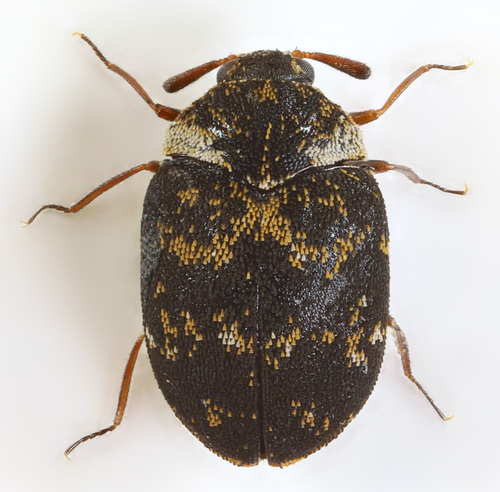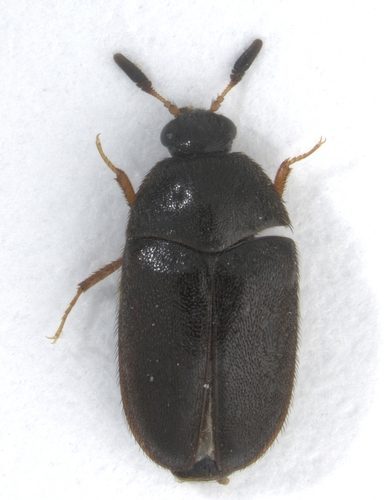
About Attagenus unicolor (Brahm, 1790)
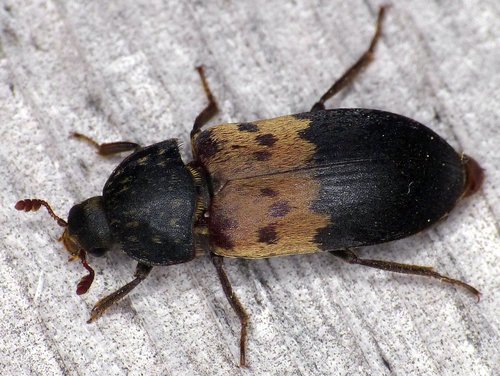
The black carpet beetle, Attagenus unicolor, is a beetle 3–5 millimetres (0.12–0.20 inches) long that can become a serious household pest. Fully grown larvae reach 7 millimetres (0.28 inches) in length; they are reddish brown and covered with bristles. Larvae feed on natural fibres, damaging carpets, furniture, and clothing.
Attagenus unicolor develops through complete metamorphosis, with four distinct life stages: egg, larva, pupa, and adult. Each stage has a different appearance, and requires a different amount of time to progress to the next stage.
Adult females usually lay eggs on or near a food source. If no food source is available, females will lay eggs in dark, undisturbed locations where larvae can later feed on carpeting or clothing. They also frequently lay eggs on or near dog food and other types of pet food. Eggs hatch between 5 and 20 days after being laid, with hatching time dependent on environmental conditions like temperature and humidity.
When larvae first hatch, they are around 1 millimetre (0.039 inches) long. Their growth rate depends on the availability of food and the protein content of their food source. Larvae moult approximately 10 to 15 times, and may moult more often under certain conditions. When food is scarce, mature enough larvae can undergo retro-moulting, moulting into a smaller, earlier instar, and they may repeat this process multiple times. The larval stage is the longest and most destructive life stage of this species. Larvae can remain in this stage for up to 3 years, though they typically complete larval development in less than 3 months when food and environmental conditions are good.
Once larvae finish growing, they pupate in undisturbed locations far from their food source, to avoid being cannibalized. Fresh pupae are cream white, but quickly turn yellow and darken as they age. Pupae do not eat or move during this stage. They develop into adult beetles over 8 to 20 days, depending on environmental conditions. After developing, adults may remain inside the shed pupal case for an extra one to two days.
Newly emerged adults start out white, and darken as they age, eventually becoming solid black – this gives the species its common name of black carpet beetle. Adult black carpet beetles typically do not eat; they will sometimes feed on flower pollen in the wild, but do not feed indoors. Adults live for only a few weeks, which is just long enough to mate and lay eggs. Females can lay between 50 and 100 eggs total. When small amounts of water are available, adult females lay more eggs. Under ideal conditions, the full life cycle of Attagenus unicolor takes about 4 to 5 months, and can be shorter when larvae have access to protein-rich food like pet food.