About Atropa belladonna L.
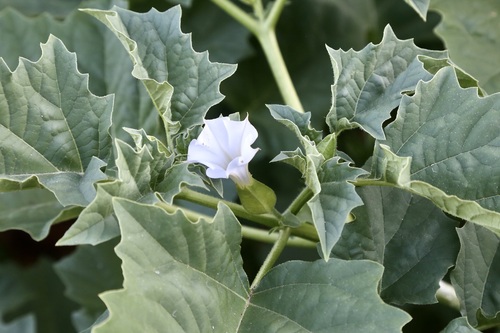
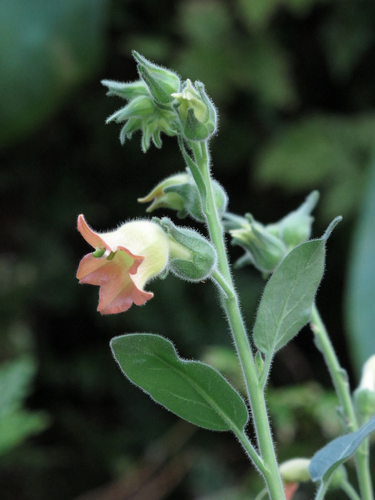
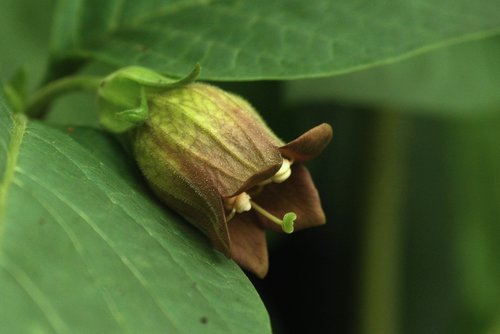
Atropa belladonna L. (commonly called deadly nightshade) is a branching, herbaceous perennial rhizomatous hemicryptophyte, which often grows as a subshrub from a fleshy rootstock. Mature plants can reach a height of 2 m (7 ft), though more commonly they grow to 1.5 m (5 ft). They bear ovate leaves that can grow up to 18 cm (7 in) long. Its flowers are bell-shaped, dull purple with yellow-green tinges toward the base, and have a faint scent. Its fruits are berries that start green and ripen to a shiny black, reaching approximately 1.5 cm (0.6 in) in diameter. The berries are sweet, and despite containing toxic alkaloids, they are eaten by animals (mainly birds) that disperse the plant's seeds via their droppings. A variety with pale yellow flowers and pale yellow fruit exists, named Atropa belladonna var. lutea. Atropa belladonna is sometimes confused with the much less poisonous black nightshade, Solanum nigrum, which is in a different genus within the Solanaceae family. A comparison of fruit shows that black nightshade berries are spherical, have a dull surface, and grow in clusters; in contrast, deadly nightshade berries are much glossier, twice as large, somewhat flattened, and grow singly. Another distinguishing feature is that black nightshade flowers are not tubular, they are white and star-shaped, with a central cone of yellow anthers. Atropa belladonna is native to temperate southern, central and eastern Europe, northwestern Africa (specifically Morocco and Algeria), and southwest Asia (specifically Turkey, Iran and the Caucasus). In the British Isles, it is native only in England, where it grows on calcareous soils, disturbed ground, field margins, hedgerows and open woodland; it is more widespread as an introduced alien species, including in Wales, Scotland, and Ireland, where it persists as a relic of cultivation for medicinal use. It has been introduced and cultivated outside its native range for a long time, and is now naturalized north and west of its native range in Europe, as well as in parts of North America, China, Australia, and New Zealand. It often grows in shady, moist locations with limestone-rich soils. In southern Sweden, it was recorded in the Flora of Skåne in 1870 as grown in apothecary gardens near Malmö. It is classified as a weed species in parts of the world, where it colonizes areas with disturbed soils. Deadly nightshade is one of the most toxic plants known, and oral consumption increases health risks for people with numerous clinical conditions, including pregnancy complications, cardiovascular diseases, gastrointestinal disorders, and psychiatric disorders, among others. All parts of the plant contain tropane alkaloids; the concentration by weight is up to 1.3% in roots, 1.2% in leaves, 0.65% in stalks, 0.6% in flowers, 0.7% in ripe berries, and 0.4% in seeds. Alkaloid content in leaves reaches its maximum when the plant is budding and flowering, while roots are most poisonous at the end of the plant's vegetation period. Bees use the plant's nectar to make honey that also contains tropane alkaloids. The berries pose the greatest danger to children, because they look attractive and have a somewhat sweet taste. The root of the plant is generally the most toxic part, though toxicity can vary between individual specimens. The active compounds in deadly nightshade are atropine, hyoscine (scopolamine), and hyoscyamine, all of which have anticholinergic properties. Symptoms of poisoning include dilated pupils, sensitivity to light, blurred vision, tachycardia, loss of balance, staggering, headache, rash, flushing, severely dry mouth and throat, slurred speech, urinary retention, constipation, confusion, hallucinations, delirium, and convulsions. In 2009, an adult woman mistook A. belladonna berries for blueberries; documented records show that eating six of the berries resulted in severe anticholinergic syndrome. Deadly symptoms are caused by atropine disrupting the parasympathetic nervous system's ability to regulate involuntary activities such as sweating, breathing, and heart rate. The antidote for belladonna poisoning is an anticholinesterase (such as physostigmine) or a cholinomimetic (such as pilocarpine), which is the same antidote used for atropine poisoning. Atropa belladonna is also toxic to many domestic animals, causing narcosis and paralysis. However, cattle and rabbits can eat the plant apparently without suffering harmful effects. In humans, its anticholinergic properties disrupt cognitive capacities such as memory and learning. Due to its toxicity, it is advised not to handle the plant without wearing gloves, and it is also cautioned that the plant should not be eaten. Even extremely small doses of consumed belladonna can cause death. Additionally, Atropa belladonna is known to cause negative psychological effects in people who come into contact with it, including insomnia, local paralysis, dizziness, and alternating mental states shifting between excitement and severe agitation. Belladonna has been used in herbal medicine for centuries as a pain reliever, muscle relaxer, and anti-inflammatory, and to treat menstrual problems, peptic ulcer disease, histaminic reaction, and motion sickness. At least one 19th-century eclectic medicine journal explains how to prepare a belladonna tincture for direct administration to patients. In homeopathic practices, belladonna was prescribed by German physician Samuel Hahnemann as a topical medication for inflammation and pain, diluted to such an extent that no actual plant material remains in the preparation. In the form of Doktor Koster's Antigaspills, belladonna was sold as a homeopathic medication for upset stomach and excessive flatulence, again with no actual belladonna present in the medication. There is insufficient scientific evidence to support the use of belladonna for these or any other clinical disorders. In 2010 and 2016, the US Food and Drug Administration warned consumers against using homeopathic teething tablets and gels containing belladonna for infants and children, stating that the products may be toxic, causing seizures, difficulty breathing, lethargy, excessive sleepiness, muscle weakness, skin flushing, constipation, difficulty urinating, or agitation. This risk is especially high for lower potencies, which counterintuitively are more likely to contain measurable belladonna because they are less diluted. The tropane alkaloids of A. belladonna were historically used as poisons, and early humans made poisonous arrows from the plant. In ancient Rome, it was allegedly used as a poison by Agrippina the Younger, wife of Emperor Claudius, on the advice of Locusta, a woman who specialized in poisons, and Livia, who is rumored to have used it to kill her husband, Emperor Augustus. The Scots used it during a truce to poison the troops of invading English king Harold Harefoot, leaving the English troops unable to hold their position and forcing them to retreat to their ships. Medical historians also suspect that Solomon Northup, a free Black man who was kidnapped and sold into slavery in 1841, was poisoned using a combination of Atropa belladonna and laudanum. Atropa belladonna is rarely grown in gardens, but when it is cultivated, it is usually grown for its large upright habit and showy berries. Germination of the small seeds is often difficult, due to hard seed coats that cause seed dormancy. Germination takes several weeks under alternating temperature conditions, but can be sped up with the use of gibberellic acid. Seedlings require sterile soil to prevent damping off (a disease caused by soil-borne pathogens that weakens seedlings during germination), and care must be taken to avoid root disturbance during transplanting, as the plants do not tolerate root disturbance well. There is insufficient scientific evidence to recommend using naturally occurring A. belladonna for any health condition, though some of its components, particularly l-atropine, which was first purified from belladonna in the 1830s, have accepted medical uses. Donnatal is a prescription pharmaceutical that combines natural belladonna alkaloids in a specific fixed ratio with phenobarbital to provide peripheral anticholinergic/antispasmodic action and mild sedation. Donnatal contains 0.0194 mg of atropine. According to the FDA and Donnatal product labeling, it is possibly effective as adjunctive therapy for the treatment of irritable bowel syndrome (also called irritable colon, spastic colon, mucous colitis) and acute enterocolitis. Donnatal is not approved by the FDA as either safe or effective. According to the FDA, Donnatal use carries significant risks: it can cause harm to a fetus if administered to a pregnant woman, can lead to heat prostration if used in hot climates, may cause constipation, and may produce drowsiness or blurred vision. The Towns-Lambert, or Bella Donna, Cure was a treatment regimen for alcoholism developed in the early 20th century.