About Atriplex vesicaria Heward ex Benth.
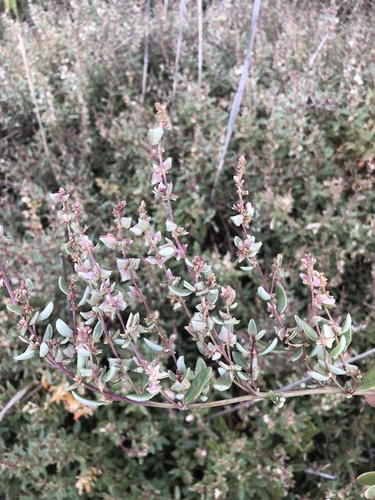
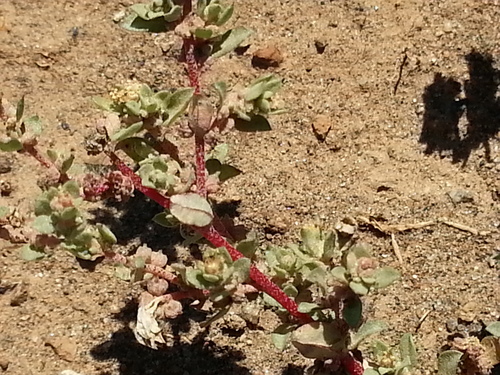
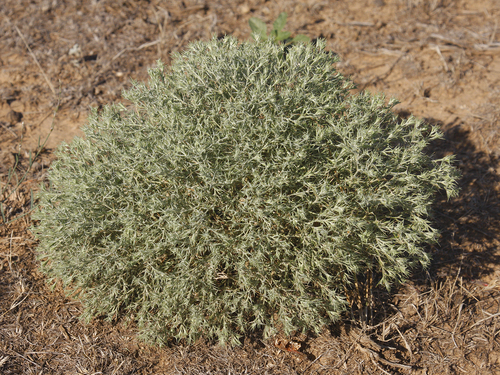
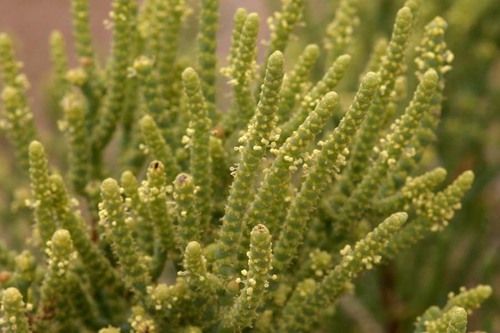
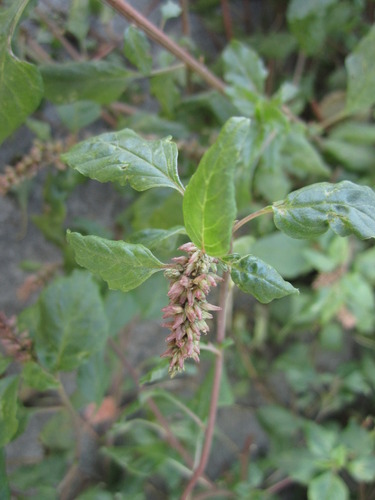
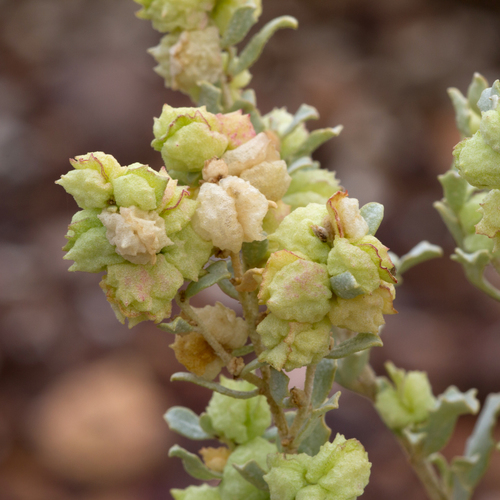
Atriplex vesicaria Heward ex Benth. is a perennial shrub that grows upright or sprawling, reaching up to 1 metre (3 feet 3 inches) in height. Its leaves are sessile, ranging in shape from elliptic to oblong or egg-shaped with the narrower end at the base, between 5 and 25 millimetres (0.20 to 0.98 inches) long and 3 to 15 millimetres (0.12 to 0.59 inches) wide, and covered in scales. Leaf margins are typically entire, but may occasionally be toothed, and leaf tips are either pointed or blunt. The species is predominantly dioecious, meaning male and female flowers are usually borne on separate plants, though hermaphroditic, bisexual variations have been recorded. Some plants are bisexual, and the species can alter its sexual state from one season to the next. Sexual expression responds to weather, light intensity, temperature, soil fertility and moisture, disease, plant age, injury, grazing intensity, and population density. Male plants usually bear flowers in clusters on simple or branched panicles or spikes that are 20 to 40 millimetres (0.79 to 1.57 inches) long. Male flowers have five similar perianth segments, and appear either continuously or in interrupted clusters on thin, simple or branched terminal spikes or panicles. Female flowers are borne in clusters of two to many in upper leaf axils, lack a perianth, and have their ovary surrounded by two bracteoles. After flowering, the bracteoles swell to 3 to 14 millimetres (0.12 to 0.55 inches) long and 5 to 15 millimetres (0.20 to 0.59 inches) wide, and usually have a thin-walled, bladder-like appendage attached. The fruiting body is 6 to 15 millimetres in diameter, green to cream coloured, mostly orbicular and membranous, with fine veins networked throughout, concealed by inflated spongy appendages, and holds seeds between bracts. This species is a widespread halophytic shrub that occurs across chenopod shrublands in arid and semi-arid inland areas of southern Australia, and has been recorded in Western Australia, the Northern Territory, South Australia, Queensland, New South Wales, and Victoria. It grows on alluvial plains, coastal dunes, salt pans, salt lakes, sandy plains and limestone ridges. In New South Wales, it occurs on clay soils in the western Riverine Plains, stony soils in the north west, and texture-contrast soils in the south west. In Victoria, it grows in the Lowan Mallee, Murray Mallee, Victorian Volcanic Plain, Murray Scroll Belt, and the Robinvale Plains. Bladder saltbush, the common name of this species, is relatively long-lived, with a 25 to 30 year lifespan. Over large areas, it may grow as the only shrub species, or as a co-dominant shrub alongside other perennial shrubs. It is adapted to dry environments, and as a halophyte it can tolerate salty soils. In dry conditions, the plant sheds its leaves to conserve moisture. Recruitment happens opportunistically in favourable conditions, particularly after rainfall. Flowering and seed set can occur multiple times per year. Saltbush is currently considered somewhat of a delicacy used in modern cuisine. It is known for its salty, earthy, herbal flavour, and can be added to meat and vegetable dishes or used as a salt substitute.