About Atriplex semibaccata R.Br.
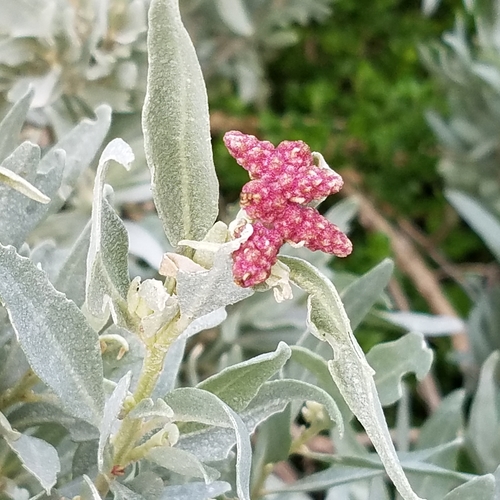
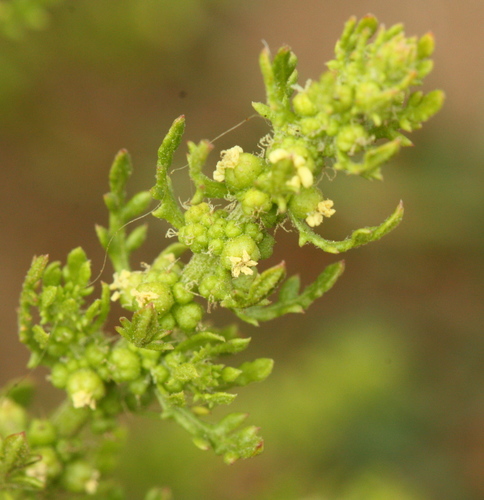
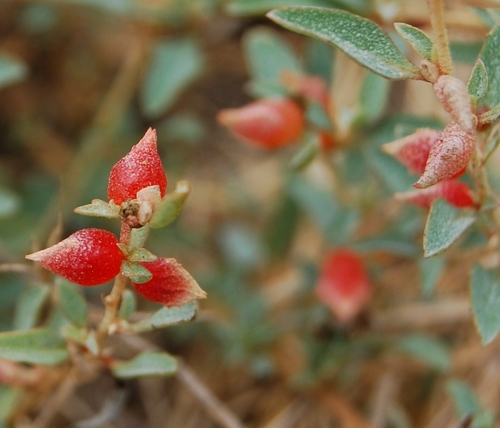
Atriplex semibaccata R.Br. is a taprooted perennial herb with prostrate and decumbent growth habits. It is native to Australia and widespread across all mainland Australian states, thriving in harsh, saline conditions. It often grows as a mat or in a semi-erect form, reaching 40–80 cm in height and spanning 1.5 to 2 meters in diameter. Its slender branches grow from a woody taproot. Young leaves are white scruffy, subsessile (on small stalks), and spatulate or obovate (oblong or elliptic). Mature leaves develop a green to grey-green colour, measure 5–30 mm long by 2–9 mm wide, have tapered bases and obtuse tips, and are thin, oblong-elliptic, obtuse with short 1–2 cm petioles. This species is monoecious: staminate flowers are tiny, terminal, and 1.5 mm wide, while pistillate flowers grow in clusters distal to the leaves. Mature fruiting bracteoles are red or orange, convex, and rhombic (diamond-shaped). Fruits are succulent, united at the base, have toothed margins, are sessile, and measure 4–6 mm in length. Atriplex semibaccata reproduces by seed, and produces dimorphic seeds: black seeds are 1.5–1.7 mm, while brown seeds are 2 mm in size. It can be used as fodder, and is useful for restoring degraded or salt-affected land. Its optimal habitat conditions include a dry or subtropical climate and full direct sunlight. It is of year-round horticultural interest and has a plant hardiness rating of zone 4. It requires light hydration, and can grow in clay, loam, peat, sand, or silt soils with a neutral pH. This saltbush species is endemic to Australia, originally native to Western Australia, South Australia, Queensland, and New South Wales. It has become naturalised in the Australian Capital Territory, on Norfolk Island, and possibly Tasmania. It has also been introduced to North and South America, North Africa, the Horn of Africa, the Middle East, Arabian Peninsula, Asia, and the Mediterranean region. It was introduced to regions around the world as a drought- and salt-tolerant fodder crop, and was introduced to Tasmania specifically for grazing purposes. It grows in slightly saline heavy soil, in woodland near salt lakes, and typically colonises disturbed areas. It was first recorded in California in 1901, planted as livestock forage in alkaline regions. Its seeds were distributed in 1916, and by 1940 the species occupied southern coastal California and scattered inland areas. All members of the genus Atriplex use C4 photosynthesis, a trait that contributed to the genus's evolutionary success. Unlike many other C4 Chenopodiaceae plants, Atriplex species have Kranz anatomy: a layer of bundle sheath cells surrounding the vascular bundle, paired with radially arranged palisade cells, with little variation in C4 leaf types across the genus. Atriplex semibaccata can adapt to its immediate environmental conditions, including changes in air temperature, soil moisture, salinity, and evaporation. Increased exposure to a saline environment triggers a salt stress response: it produces fewer chloroplasts in chlorenchyma and bundle sheath cells, and has reduced root diameter, smaller leaf size, lower leaf stromal conductance, and a lower net leaf photosynthetic rate. Higher saline exposure also increases intracellular CO₂ concentration and the number of stomata per unit leaf area. Atriplex semibaccata becomes dormant during winter, while many other Atriplex species remain active. It can adapt to conditions including low and inconsistent rainfall, variable temperatures and humidity, and poor-quality soil. The essential oils of Atriplex semibaccata contain compounds with antibacterial and antioxidant properties. These essential oils are moderately synergistic with gentamicin, an antibiotic used to treat a range of bacterial infections. Atriplex semibaccata is suitable for revegetating marginal lands, and its biomass can be used to produce essential oils for controlling microbial infections. Alcohol extracts from this species contain compounds including scopoletin, coumarin, scopolin, umbelliferone, 7-methoxy coumarin, phenolic acid, and P-coumaric acid, all of which have antibacterial activity. Isolated compounds from Atriplex semibaccata, specifically tyramine and lignanamide, exhibit cytotoxic activity against the proliferation of leukemia lymphoblast (CCRF-CEM) cells.