About Atriplex nummularia Lindl.
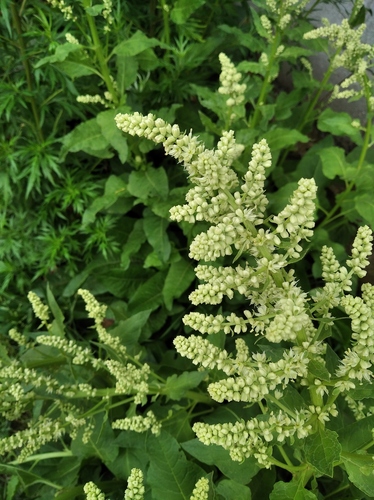
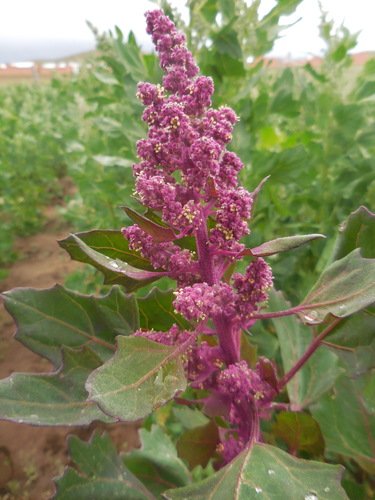
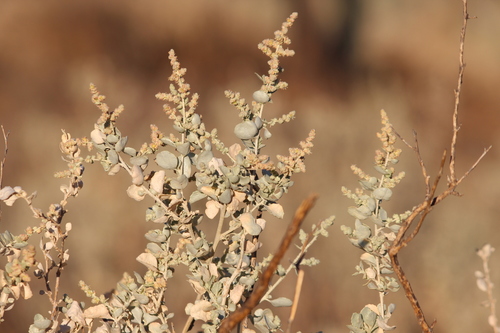
Atriplex nummularia Lindl. is an extremely hardy perennial halophyte that grows well in particularly harsh environments, including saline and alkaline lowlands. It is the largest species of Australian saltbush, typically reaching 2 to 4 meters wide and up to 3 meters tall, with a growth habit that is either sprawling or erect. The plant forms a network of woody stems that branch from or close to ground level, and has a taproot with a moderate to deep overall root system. It is evergreen, with simple alternate leaves that are often irregularly shaped, ranging from circular to triangular, and frequently have dull teeth. Leaves measure 1 to 5 centimeters long, have a scaly texture, and are covered in a silvery-grey coating on both sides. While hermaphroditic variants with bisexual flowers have been recorded, this species is generally considered dioecious, meaning male and female flowers grow on separate individual plants. Male flowers grow in separated bead-like clusters at the ends of branches, while female flowers grow in dense clusters along panicles that are typically around 20 centimeters long. After a female flower is fertilized, its leafy bracts enlarge to surround the developing seed. Mature seeds are usually round, have a thick woody seed coat, and are reddish-brown overall. The fan-shaped fruiting bracteoles are only attached at the base, and typically grow 0.5 to 1 centimeter wide. Originally native to Australia, Atriplex nummularia occurs naturally in New South Wales, the Northern Territory, Queensland, South Australia, Victoria, and Western Australia. In its native range, it usually grows on saline, low-lying clay soils like floodplains, but it is highly adaptable and can grow in most soil types. It also thrives in temperate and sub-tropical regions around the world, and is found throughout Taiwan and many parts of Oceania. It has been introduced to most Middle Eastern and North African countries, as well as South Africa, Mexico, Chile, Spain, and the USA. Across both the Northern and Southern hemispheres, A. nummularia is typically found in lowland areas such as floodplains, and favors saline clay soils. Atriplex nummularia generally produces small wind-pollinated flowers throughout the winter months (June to August), though flowering timing can vary with seasonal temperature changes. Seed production varies very widely, and saltbush fruit often contains no seeds. Seeds that do develop usually mature during the spring months (September to November). Atriplex nummularia is one of the most widely used forage shrubs in Australia, and is commonly cultivated for livestock fodder. It is valued for this purpose because it can survive harsh conditions including flooding, drought, and high soil salinity, and is palatable to livestock thanks to the plant's high mineral content. The plant's seeds are a traditional food source for many Australian Aboriginal communities, who eat them on their own or as part of other dishes. A. nummularia is also used as a windbreak, livestock shade, crop shelterbelt, screen or hedge, firebreak, and for erosion control and soil binding. It is particularly useful for stabilizing sand dunes and rehabilitating eroded or damaged soils. The Noongar people eat grubs found in the plant's roots raw or roasted. Noongar people also mash the leaves and roots, boil them in water, and use the resulting preparation to bathe skin sores, wounds, and burns. Early settlers reportedly drank the same boiled preparation to treat scurvy.