About Atrina fragilis (Pennant, 1777)
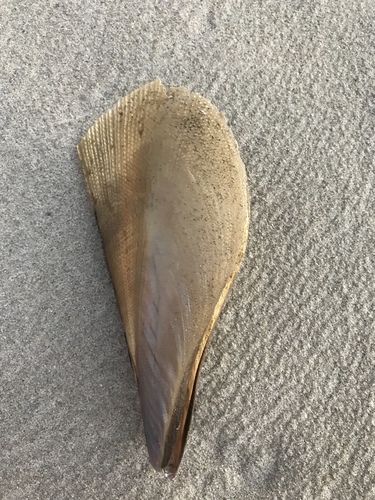
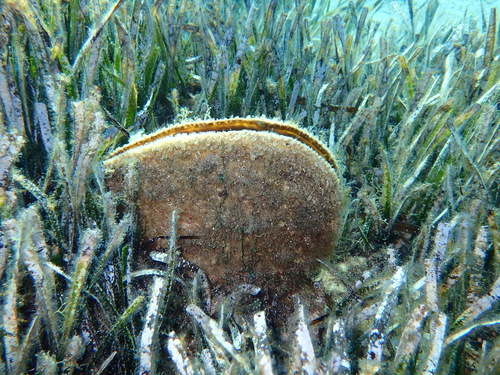
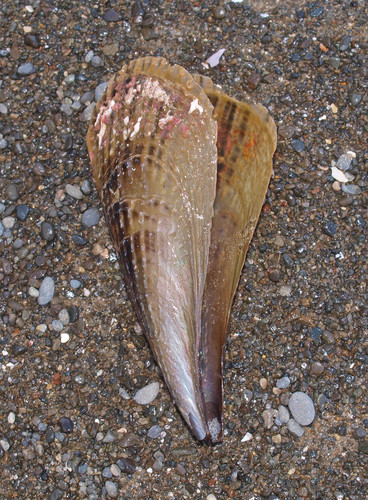
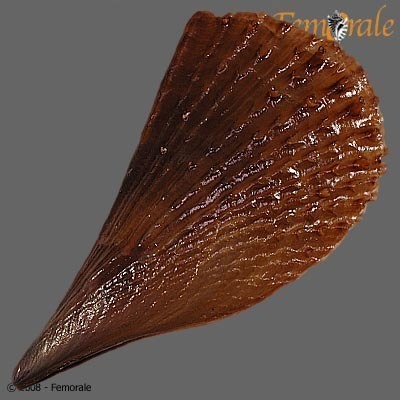
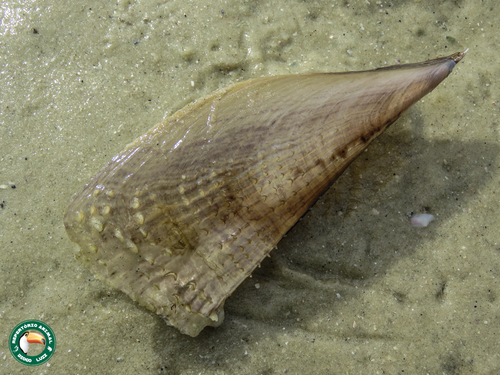
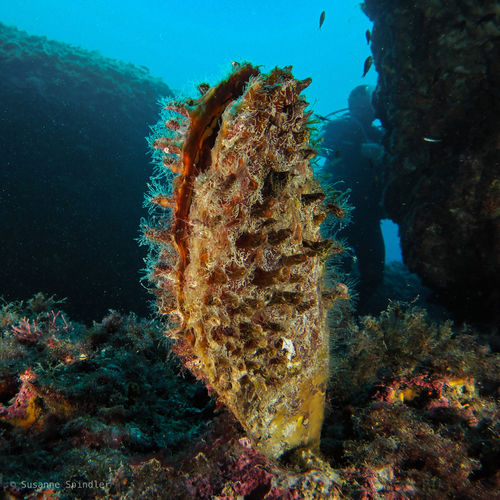
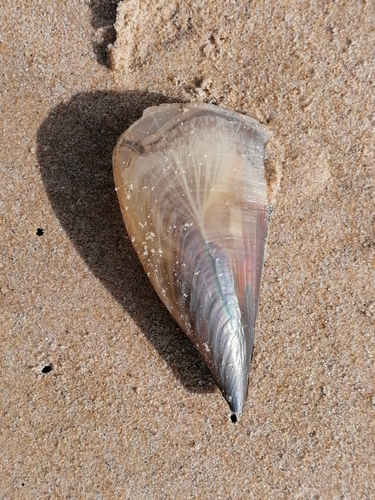
This species, commonly called the fan mussel, has the scientific name Atrina fragilis (Pennant, 1777). Its shell tapers to a point at the umbos, and is very brittle. The shell color ranges from yellowish to dark brown, with blackish patches. The two valves are equal in size and triangular in outline, with prominent gapes between them. The shell surface has a sculpture made up of concentric lines and 8 to 12 ribs, which may bear fluted spines. Adult shells can reach a maximum length of 48 cm, and the largest individuals are estimated to be 10 to 12 years old. Atrina fragilis has been found in the Mediterranean Sea. Atrina fragilis has a large shell, measuring 30–48 cm long and 15–24 cm wide, that is triangular, thin and fragile, tapering to a point. It has two equal valves with prominent gaps between the two shells, and a hinge located on the dorsal side. The shell displays concentric growth and disturbance lines, with 8–12 low, wavy ridges radiating out from the umbones. Shell color ranges from light golden or yellow-brown to darker brown or chestnut. Atrina fragilis is a rare bivalve. The most recent records of this species from the British Isles are from deep waters around Scotland's Shetland Isles and Orkney, and the west coast of Scotland, with scattered records from north-east Scotland, the south coast of England, the Channel Isles, Pembrokeshire in south Wales and Northern Ireland. It has also been recorded from north Scotland down to Mauritania, including the Iberian Peninsula, and into the Mediterranean. Atrina fragilis lives embedded in sediments in the sublittoral fringe down to approximately 400 m depth, occurring in subtidal muds, sandy muds or gravels. Like many other mussels, the fan mussel attaches to small stones by secreting strong byssal threads through its byssus gland, to avoid being swept away by ocean currents. Even though it is embedded in sediment, only between one and two thirds of its shell is buried, which leaves the fan mussel vulnerable to damage from fishing trawlers. The overall biology of A. fragilis is not well understood, and information on its reproduction and early life-history is particularly sparse; no descriptions of A. fragilis larvae exist in earlier scientific literature. Growth lines have been used to estimate the age of adult bivalves. Concurrent molecular and morphological analyses found that early-stage larvae were present in the water column during late summer and early autumn. This suggests that A. fragilis follows the same summer and winter spawning pattern seen in other pinnids at temperate latitudes. The pelagic larval stage is believed to last four months, before larvae settle in the benthic region to develop into adult bivalves. DNA barcoding has been used to identify the largely undocumented larvae of Atrina fragilis. This technique will allow scientists to identify fan mussel habitats and oceanic larval distribution, so that proper conservation efforts can be implemented in these areas in the future.