About Atractosteus tropicus Gill, 1863
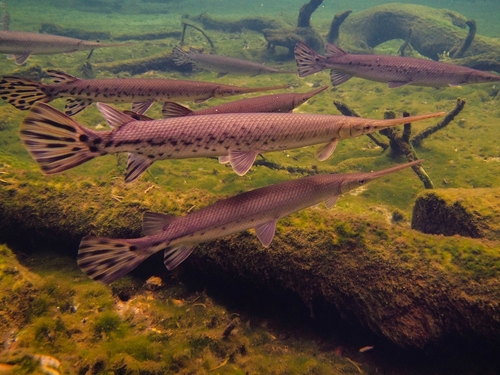
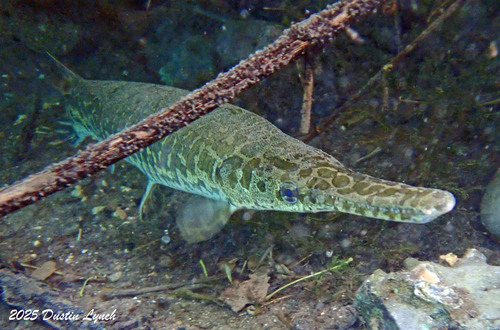
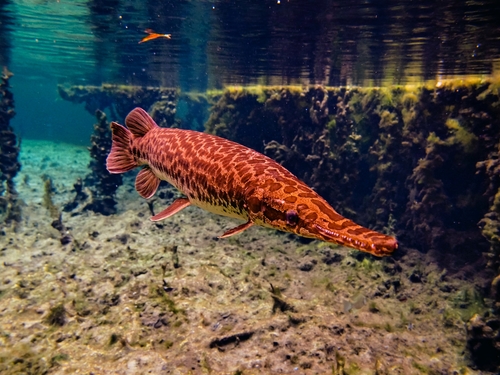
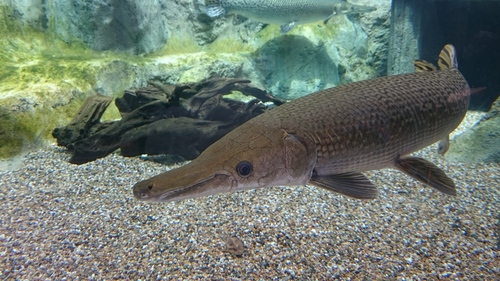
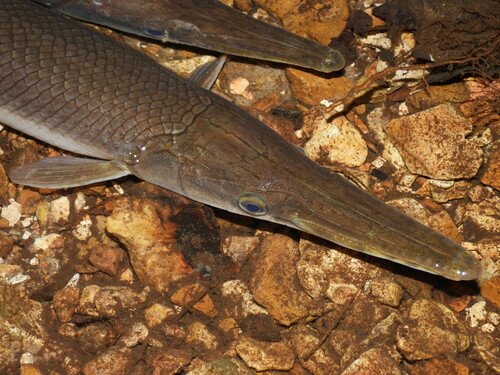
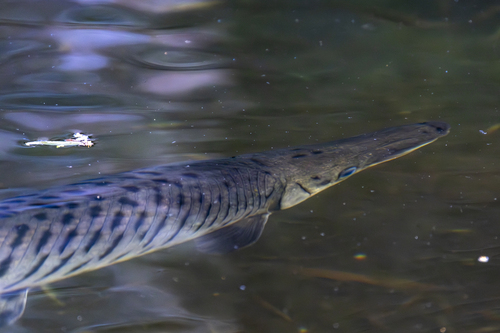
The tropical gar (Atractosteus tropicus Gill, 1863) has a long, torpedo-shaped body and an elongated snout. Its body is grey-green, marked with dark, asymmetrical patterns that are more common toward the front of the fish, where they grow larger and more intense. Like most fish, it has a lateral line along its body lined with neuromasts (clusters of sensory hairs) that detect water currents and help the fish position itself in the water column. Its body is covered in thick, diamond-shaped ganoid scales, an ancestral trait unique to gars and bichirs. These scales provide protection, and their extra weight helps the fish maintain its position in moving water. Tropical gar have pectoral fins located just behind the skull, and a pair of pelvic fins on the midsection of the body. The dorsal and anal fins sit close to the fish’s rounded caudal fin, positioned at roughly the same distance from the head along the body. Like other members of the gar family Lepisosteidae, the tropical gar has an elongated jaw compared to most other freshwater fish. This trait is thought to be an adaptation that helps the fish catch live prey. The jaw operates through a primitive lever-like mechanism, making it one of the fastest jaw structures among living fishes. The jaw is lined with sharp, conical teeth made of ganoid material (similar to the fish’s scales), and these teeth are replaced quickly through rapid turnover. Atractosteus tropicus is the smallest of the seven living gar species. It reaches a maximum length of 1.25 meters (4 ft) and a maximum weight of 2.9 kg (6.4 lbs), though most adult individuals are smaller than 1 meter. This species shares a similar coloration with the longnose gar, but can be distinguished by its smaller, broader snout. Additionally, longnose gar have a more slender, longer body than tropical gar. The tropical gar is found across southern Mexico and Central America, living in both Pacific and Atlantic drainage basins. Separate populations in the Atlantic basin occur from the Coatzacoalcos River basin to the Usumacinta River basin, and from the Nicaragua River basin to Costa Rica. In the Pacific basin, the species ranges from southern Chiapas in Mexico to the Negro river basin in Nicaragua. Tropical gar live in rivers, vegetated wetlands, and some individuals have been recorded in estuaries. The species thrives in water temperatures between 25 °C and 32 °C. It is a bimodal breather, meaning it can breathe through both air and water. This adaptation allows it to survive in deoxygenated environments, including the shallow pools that form during the wet season in Central America.