About Atractosteus spatula (Lacepède, 1803)
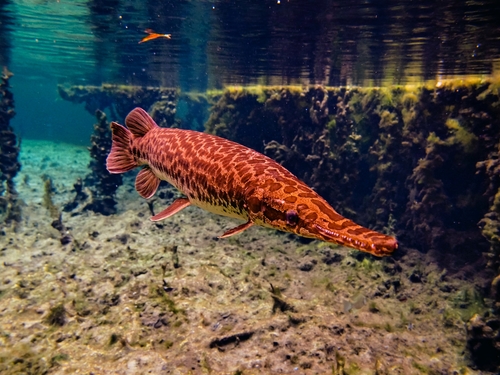
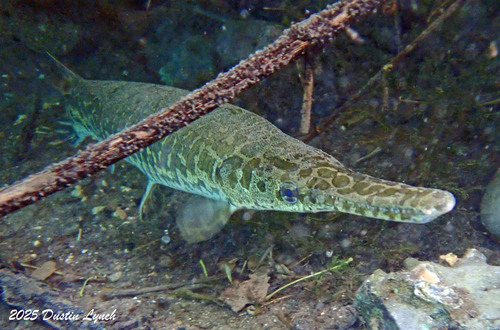
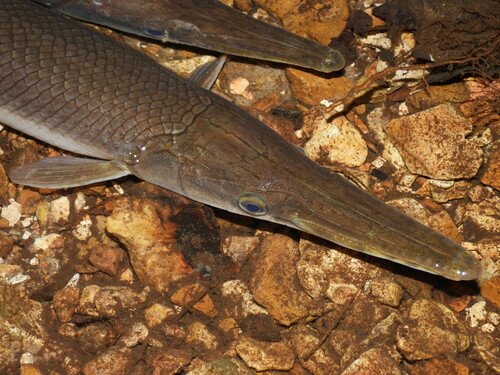
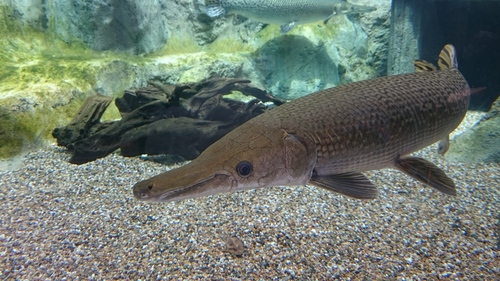
The alligator gar, with the scientific name Atractosteus spatula, is a euryhaline ray-finned fish that belongs to the clade Ginglymodi within the infraclass Holostei, and is most closely related to bowfins. It is the largest species in the gar family, Lepisosteidae, and ranks among the largest freshwater fish native to North America. The fossil record shows that the group this species belongs to has existed since the Early Cretaceous, over 100 million years ago. Gars are often called "primitive fishes" or "living fossils" because they have kept several morphological traits of their early ancestors. These traits include a spiral valve intestine, a feature also common in the digestive systems of sharks, as well as the ability to breathe both air and water. The species' common name comes from its resemblance to the American alligator, especially its broad snout and long, sharp teeth. It is suggested that alligator gar can grow to lengths of up to 10 feet (3.0 meters). The body of an alligator gar is torpedo-shaped, and is typically brown or olive, fading to a lighter gray or yellow on its underside. Very rarely, alligator gar may be black, a coloration seen in individuals with high melanin levels. Their scales differ from those of most other fish; they are ganoid scales, which are bone-like, rhombus-shaped, often have serrated edges, and are covered in an enamel-like substance. Ganoid scales are nearly impossible to penetrate, and provide excellent protection from predators. Unlike other gar species, the upper jaw of an alligator gar has a double row of large, sharp teeth that are used to impale and hold prey. Alligator gar are stalking ambush predators that feed primarily on fish, but will also ambush and eat waterfowl and small mammals found floating on the water surface. Alligator gar populations have been wiped out from most of their historic range, due to habitat destruction, uncontrolled culling, and unregulated harvesting. Today, their populations are primarily found in the southern United States, extending into Mexico. They are classified as euryhaline because they can adapt to a wide range of salinities, from freshwater lakes and swamps to brackish marshes, estuaries, and bays along the Gulf of Mexico. For nearly half a century, alligator gar were considered "trash fish" or a "nuisance species" that harmed sport fisheries, and were targeted for elimination by United States state and federal authorities. In the 1980s, improved understanding of the ecological balance required to maintain healthy ecosystems eventually led to recognition that alligator gar are an important part of the ecosystems they live in. Over time, state and federal resource agencies granted some level of protection to alligator gar. They are also protected under the Lacey Act, which makes transporting certain fish species in interstate commerce illegal when it violates state law or regulation. Multiple state and federal resource agencies monitor wild alligator gar populations, and have created public outreach programs to educate people about the species. Alligator gar are raised in ponds, pools, raceways, and tanks by federal hatcheries for mitigation stocking, by universities for research, and in Mexico for human consumption. Alligator gar occupy a wide variety of aquatic habitats, but most are found in the southern United States, in reservoirs, lakes, lowland river backwaters, and the brackish waters of estuaries, bayous, and bays. They occur south along the Gulf Coast of Texas into Tamaulipas and northern Veracruz, Mexico; however, past records from Nicaragua and Costa Rica are considered suspect and have been refuted. They have occasionally been observed in the Gulf of Mexico itself. In Texas and Louisiana, large alligator gar are commonly seen breaking the surface in reservoirs, bayous, and brackish marshes. They are found across the lower Mississippi River Valley, the Gulf Coast states of the southern United States, and Mexico as far south as Veracruz, including the U.S. states of Texas, Oklahoma, Louisiana, Kentucky, Mississippi, Alabama, Tennessee, Arkansas, Missouri, Illinois, and Florida. Reports note that alligator gar were once abundant across most of their northern range, but valid current sightings are rare, occurring only once every few years. Records of historical distribution show that alligator gar once lived as far north as central Kansas, Nebraska, Ohio, Iowa, and west-central Illinois, where they are now classified as extirpated. The most northerly confirmed alligator gar catch was taken in Meredosia, Illinois in 1922. In 2016, reintroduction efforts for alligator gar were carried out between Tennessee and Illinois, as part of a project to control invasive Asian carp. Outside of their natural range, alligator gar are an invasive species in mainland China, where they can be bought as an exotic pet fish. Because of their large size and armored scales, they have almost no natural predators even within their native range, and their poisonous eggs can create a passive threat to other fish. The species has been recorded in eight Chinese provinces, and authorities have worked to remove them. In November 2008, a broadhead gar of the genus Atractosteus, measuring 5.2 to 6.4 feet (1.6 to 2.0 meters), was caught in the Caspian Sea north of Esenguly, Turkmenistan, by two officials from Turkmenistan Fishery Protection. On September 4, 2009, a 3 foot 3 inch (0.99 meter) alligator gar was found in Tak Wah Park in Tsuen Wan, Hong Kong. Over the following two days, at least 16 more alligator gar, the largest measuring 4.9 feet (1.5 meters), were found in park ponds in Hong Kong. Local residents reported that aquarium hobbyists had released the alligator gar into the ponds, and they had lived there for several years. After a citizen falsely identified the alligator gar as crocodiles, headlines in major local Hong Kong newspapers began using terms like "horrible man-eating fish". Officials from the Leisure and Cultural Services Department removed all of the alligator gar from the Tak Wah Park ponds, because they were concerned that the large carnivorous fish could harm children. It is not unusual for the large sharp teeth and appearance of alligator gar to trigger unreasonable fear in people who do not know the species. Sensational news reports have spread misconceptions about alligator gar attacking humans, but none of these reports have ever been confirmed. On January 21, 2011, an alligator gar measuring 4 feet 11 inches (1.50 meters) was caught in a canal in Pasir Ris, Singapore by two recreational fishermen. The fish was taken to a nearby pond, where the owner confirmed it was an alligator gar rather than an arapaima, which the two fishermen had initially thought it was. There are anecdotal reports of alligator gar captured in different parts of India, but these are believed to come from accidental releases by aquarium hobbyists and similar sources. In August 2015, an alligator gar was found tangled in cloth inside a well in Dadar, where it had lived for quite some time. Animal activists rescued the fish and returned it to the well unharmed. In June 2016, a 3.5-foot alligator gar was caught from Subhash Sarovar Lake in Kolkata. Other incidents over the years have been random, ranging from captures in coastal waters during environmental assessments to captures in private ponds. On June 27, 2020, an alligator gar measuring 112 cm (3 feet 8 inches) was found dead on the shore of Gonyeli Baraji reservoir, North Cyprus. Specialists from the Cyprus Wildlife Research Institute collected the fish and confirmed it was an alligator gar (Atractosteus spatula). It is suspected the fish had been released recently and could not survive the local environment, though it is also possible it had lived there for years. A necropsy was planned to learn more. Similarly, on May 12, 2023, an alligator gar measuring less than 2 feet was caught during deweeding work in Kashmir's Dal Lake, near the Sher-i-Kashmir International Conference Centre (SKICC), which sparked concerns about potential impacts on the local ecosystem. In Thailand, alligator gar have long been known as an imported aquarium fish. When found in local natural water bodies, they are believed to have been released by aquarium keepers. In 2024, they were reported in the Mekong River in Chiang Rai Province, which forms the natural border between Thailand, Laos and Myanmar, found alongside Siberian sturgeon.