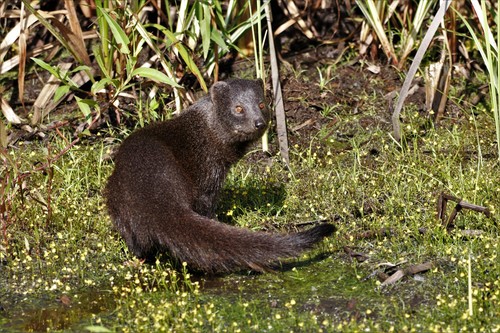
About Atilax paludinosus G
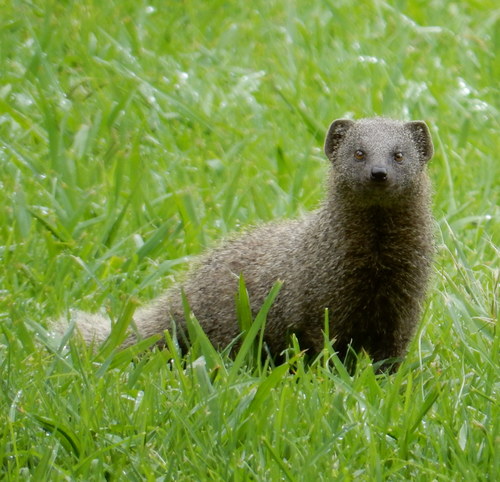
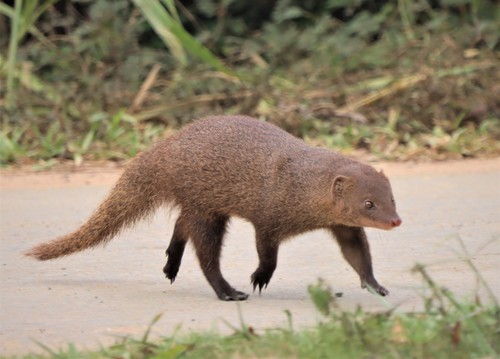
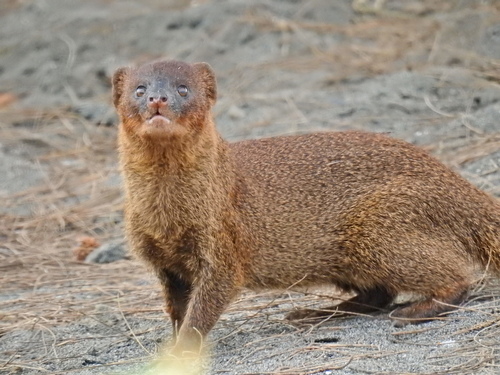
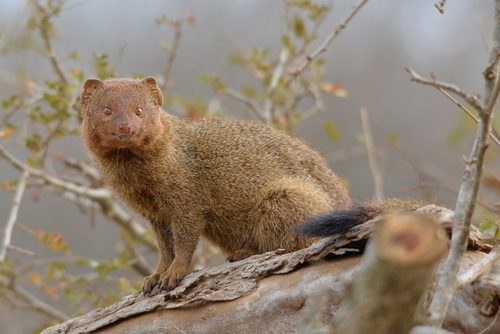
Characteristics: The fur of the marsh mongoose (Atilax paludinosus G) ranges from dark reddish brown to black, with white and fawn-colored guard hairs. Hair is short behind the neck and in front of the back, and longer on the hind legs and tail. It has a short muzzle with a fawn-colored mouth, short whiskers, and a hairless rhinarium. It has a dental formula of 3.1.3.2/3.1.3.2 × 2 = 36 total teeth. It has short, round ears, and only two nipples. Each of its feet has five flexible digits, each equipped with a curved claw, and there is no webbing between the digits. The soles of its feet are hairless. Females have an average head-to-body length of 48.72 cm (19.18 in), while males average 51.38 cm (20.23 in); the tail length ranges from 32.18 to 34.11 cm (12.67 to 13.43 in). Adult body weight ranges between 2.56 to 2.95 kg (5.6 to 6.5 lb). Both sexes have anal glands held in a pouch that produce a musky-scented secretion. Female marsh mongooses have 36 chromosomes, while males have 35, because one Y chromosome has translocated to an autosome.
Distribution and habitat: The marsh mongoose lives across most of sub-Saharan Africa, stretching from Senegal and The Gambia to Ethiopia, and throughout most of Central Africa, Eastern Africa, and parts of Southern Africa. It lives in freshwater wetlands, marshes, and swamps along slow-moving rivers and streams, across forested, jungle, and savanna regions. It can also be found in river deltas, estuarine, and brackish-water habitats in coastal zones. It was probably introduced by humans to Pemba Island in the Zanzibar Archipelago. It was recorded in Guinea's National Park of Upper Niger during surveys carried out from 1996 to 1997. In Gabon's Moukalaba-Doudou National Park, it was only recorded in forested habitats during a 2012 two-month survey. In the Ethiopian Highlands, it has been recorded at an elevation of 3,950 m (12,960 ft) in Bale Mountains National Park.
Behaviour and ecology: The marsh mongoose is mostly a solitary species. It is a very capable swimmer and can dive for up to 15 seconds, using its feet to paddle. On land, it typically trots slowly, but is capable of moving quickly. Radio-collared marsh mongooses in KwaZulu-Natal were active from shortly after sunset until after midnight, showing a crepuscular activity pattern. A radio-collared male marsh mongoose in Dzanga-Sangha Special Reserve was most active during early mornings and late evenings, and rested during the day in burrows located in dry areas above water and mud, under dense cover of tall grasses and climbing plants.
Reproduction: After a gestation period of 69 to 80 days, female marsh mongooses give birth to litters of two to three young, which are born fully furred. The young's eyes open between the 9th and 14th day after birth; their pupils are blue at first and turn brown by three weeks of age. Their ear canals open between the 17th and 28th day after birth. Females can begin weaning their offspring as early as the 30th day, and young are completely weaned by two months of age.