About Atheris squamigera Hallowell, 1854
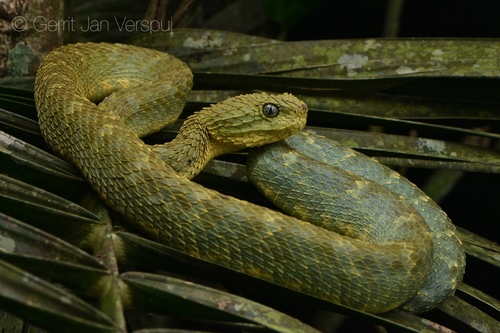
Atheris squamigera Hallowell, 1854 reaches an average total body-and-tail length of 46 to 60 cm (18 to 24 in), and maximum total length sometimes exceeds 78 cm (31 in). Females are typically larger than males. This species has a broad, flat head that is clearly distinct from the neck, with a very large mouth gape. The head is densely covered in keeled, imbricate scales. The rostral scale cannot be seen from above, a very small scale positioned just above the rostral is flanked by very large scales on each side, and the nostrils face laterally. The eye and nasal scale are separated by 2 scales. There are 7 to 9 interorbital scales across the top of the head, 10 to 18 circumorbital scales, and 2 (rarely 1 or more than 2) rows of scales separating the eyes from the labials. There are 9 to 12 supralabials and 9 to 12 sublabials; the anterior 2 or 3 of these sublabials contact the only pair of small chin shields. Gular scales are keeled. In midbody, there are 15 to 23 rows of dorsal scales, which reduce to 11 to 17 rows posteriorly. Ventral scales number 152 to 175, and there are 45 to 67 undivided subcaudals. Variation in morphometric traits may be linked to habitat. Coloration is consistent across some populations, and variable across others. Dorsal color ranges from sage green or light green, through green and dark green, to bluish, olive, or dark olive brown. Rare individuals may be yellow, reddish, or slate gray. Scales have light-colored keels, and sometimes yellow tips that form a series of 30 or more light crossbands or chevrons. There are 10 to 19 chevrons on the tail; these are not always clearly defined, but are usually present. The ventral edge of the dorsum bears paired light spots. Interstitial black pigment is only visible when the skin is stretched. The belly is yellow or dull to pale olive; it may be uniformly colored, or heavily mottled with blackish spots, and the throat is sometimes yellow. The tail has a distinct 7 to 12 mm long ivory white tip that extends back over 10 subcaudals. Newborn neonates are dark olive with wavy bars that are paler olive or yellowish olive with fine dark olive margins, spaced at 5 mm (0.20 in) intervals. Neonates have a paler greenish olive belly, and develop the full adult color pattern within 3 to 4 months. This species occurs in forest habitats of West and central Africa, ranging from Ghana eastward to western Kenya and Tanzania, and south to northern Angola and Bioko Island. Its type locality is recorded as "Near the river Gaboon, Guinea", which corresponds to modern Gabon. A. squamigera is the most widely distributed species in the genus Atheris. Researchers hypothesize that the current dispersal pattern of all Atheris species, including A. squamigera, may have been shaped by a combination of past climatic events, geological activity, tectonic plate shifts over millions of years, and stochastic dispersal. A. squamigera mostly inhabits rainforest, and prefers relatively low, thick flowering bushes. In the wild, individuals reach sexual maturity and begin breeding at 42 months old for females, and 24 months old for males. Breeding occurs once per year, most often during the wet season. This species is viviparous. A single successful breeding pair can produce up to 19 neonates, with an average litter size of 7 to 9. Females carry developing young internally during a two-month gestation period. After birth, the mother abandons the neonates, which are born venomous and completely self-sufficient.