About Atherinops affinis (Ayres, 1860)
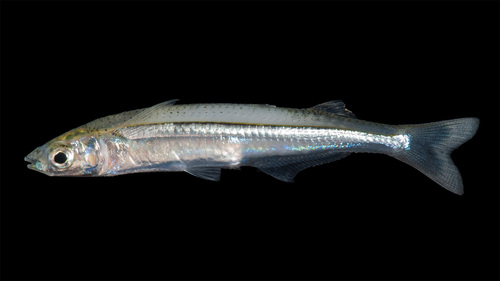
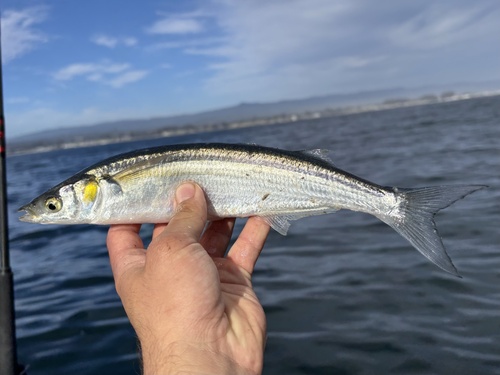
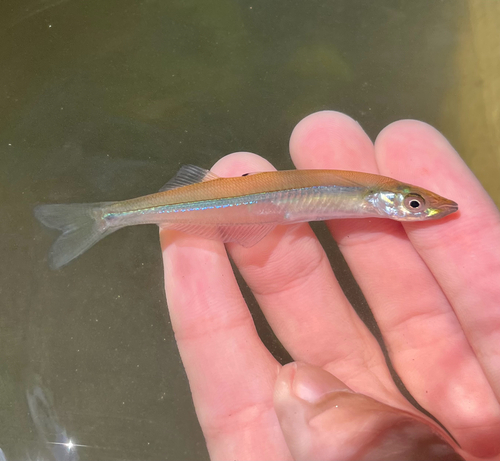
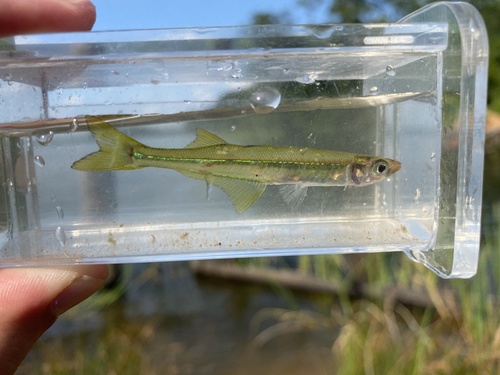
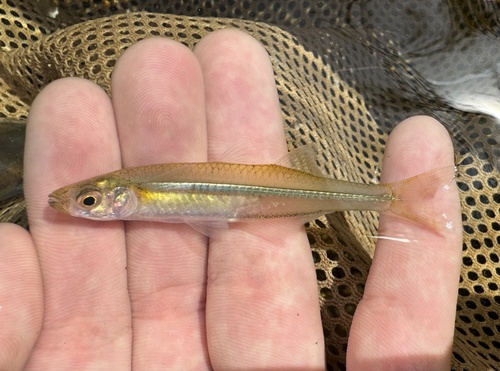
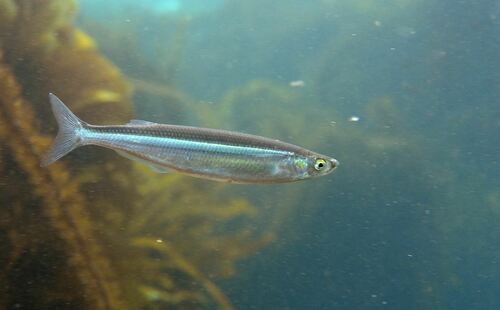
The topsmelt silverside, Atherinops affinis, is a small, slim fish with a dorsally flattened body that reaches a maximum total length of 37 centimetres (15 in). It has two separate dorsal fins on a bright green back, which contrasts with its silver to pale flanks and silvery underside. This species has a pointed head with small eyes, a rather rounded, blunt snout, and a terminal oblique mouth with extendible jaws. Each jaw holds a row of tiny forked teeth, and the gills are golden-yellow. It has no lateral line, but there are 63–65 scales along the position where the lateral line would normally occur. The first dorsal fin has 5–9 spines; the second dorsal fin has one spine and 8–14 rays. The anal fin also has a single spine and 19–25 rays, and the pectoral fin has 13 rays. Juvenile topsmelt silversides are translucent, with three rows of pigmented scales on their back; the pigmented scales become more scattered on the caudal peduncle. The topsmelt silverside is distributed in the eastern Pacific Ocean along the western coast of North America, ranging from Vancouver Island in British Columbia south to Baja California and the Gulf of California. This is a pelagic schooling fish that occupies a wide variety of habitats at different times of year. It is common in estuaries, and has also been recorded along ocean shorelines, in kelp forests, off sandy beaches, and sometimes in offshore waters. It is frequently found in and around man-made structures like pier pilings, and is most often observed just below the surface, typically within the upper 9 metres (30 ft) of the water column. During spring and summer, many topsmelt silversides move into estuaries; in autumn and winter, they shift to more open coastlines, including bays, rocky areas, and kelp beds. This species can tolerate salinities higher than seawater, and has been recorded living in salt evaporation ponds with salinities as high as 80 ppt. Topsmelt silversides spawn in warmer months, from March through October. They prefer to spawn in waters with a salinity of around 30 ppt and a temperature range of 13–27 °C (55–81 °F), and typically spawn at night over submerged vegetation. After hatching in deeper water, larvae may move up into estuaries. Juveniles less than one year old are the age group most frequently found in freshwater environments; as they age, they move downstream toward more estuarine habitats. Juveniles feed on zooplankton, while adults are primarily benthic foragers. Adult food items include algae, chironomid larvae, and amphipods. The presence of sand and gravel in adult stomach contents is taken as an indicator that this species feeds on the bottom. Topsmelt silversides are often recorded leaping out of the water to escape pursuit by larger predatory fishes such as mackerel or jacks.