About Athene noctua (Scopoli, 1769)
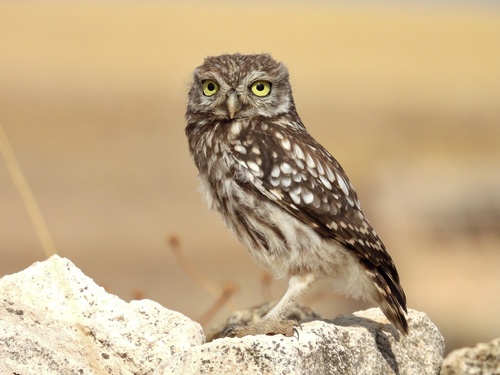
The little owl, with scientific name Athene noctua (Scopoli, 1769), is a small owl that has a flat-topped head, plump compact body, and short tail. The facial disc is flattened above the eyes, giving the bird a frowning expression. Its plumage is greyish-brown, marked with white spots, streaks, and bars. The underparts are pale and streaked with darker colour. Adults of both sexes usually measure 22 cm (8.7 in) in length, have a wingspan of 56 cm (22 in), and weigh about 180 g (6.3 oz). The most widespread form, the nominate subspecies A. n. noctua, has white-speckled brown upperparts and brown-streaked white lowerparts. It has a large head, long legs, and yellow eyes, and its white "eyebrows" give it a stern expression. Juveniles are duller than adults, and do not have the white crown spots that adults have. This species has a bounding flight pattern that resembles that of a woodpecker. Moult starts in July and continues through November, and males start moulting before females do. The most common call of this species is a querulous kiew, kiew. Less frequently, the species produces various whistling or trilling calls. During the breeding season, little owls make other more modulated calls, and a pair may even call in a duet. When near the nest, little owls produce a range of yelping, chattering, or barking sounds. The little owl is widespread across Europe, Asia, and North Africa. In Eurasia, its range extends east from the Iberian Peninsula and Denmark to China, and south to the Himalayas. In Africa, it occurs from Mauritania to Egypt, the Red Sea, and Arabia. It was introduced to the United Kingdom in the 19th century, and has since spread across most of England and all of Wales. It was introduced to Otago in New Zealand by the local acclimatisation society in 1906, and introduced to Canterbury shortly after, and is now widespread across the eastern and northern South Island. It is partially protected under Schedule 2 of New Zealand's Wildlife Act 1953, while most introduced bird species either have no protection or are classed as game birds. This is a sedentary species that lives in open countryside across a wide variety of habitats. Habitats include agricultural land with hedgerows and trees, orchards, woodland verges, parks and gardens, steppes, and stony semi-deserts. It also occurs in treeless areas such as dunes, and near ruins, quarries, and rocky outcrops. It sometimes moves into villages and suburbs. In the United Kingdom, it is mainly a lowland bird, and usually occurs below 500 m (1,600 ft). In continental Europe and Asia, it may be found at much higher elevations; one individual was recorded at 3,600 m (12,000 ft) in Tibet. In terms of behaviour and ecology, this owl typically perches in an elevated position, ready to swoop down on any small creature it spots. It feeds on prey including insects and earthworms, as well as small vertebrates such as amphibians, reptiles, birds, and mammals. It can chase prey on the ground, and caches surplus food in holes or other hiding places. Analysis of pellets of indigestible material regurgitated by the birds found that mammals made up 20–50% of the diet, and insects made up 24 to 49%. Mammals eaten include mice, rats, voles, shrews, moles, and rabbits. Birds were mostly consumed during the breeding season and were often fledglings, including the chicks of game birds. Insects eaten included Diptera, Dermaptera, Coleoptera, Lepidoptera, and Hymenoptera. Up to 5% of the diet can consist of vegetable matter, which was likely ingested incidentally. The little owl is territorial, and males normally stay in one territory for life. Territory boundaries can expand and contract, and are largest during the spring courtship season. The home range, the area where the bird actually hunts for food, varies depending on habitat type and time of year. Little owls with home ranges that include a high diversity of habitats have much smaller home ranges, less than 2 ha, than little owls that breed in monotonous farmland, which have home ranges over 12 ha. Larger home ranges lead to increased flight activity, longer foraging trips, and fewer visits to the nest. If an intruding male enters another male's territory, the territory occupier approaches and gives off territorial calls. If the intruder continues to stay, the occupier flies at it aggressively. If this attack does not work, the occupier repeats the attack, this time trying to make contact with its claws. When retreating, an owl often drops to the ground and escapes at a low level. The territory is defended more actively against an unfamiliar male than against a known male from a neighbouring territory, and research shows that little owls can recognize familiar birds by their voices. The little owl is partly diurnal, and often perches boldly and in prominent spots during the day. If little owls live in an area with a large amount of human activity, they may become used to humans and will stay on their perch, often in full view, while people are nearby. The little owl has a life expectancy of about 16 years. However, many birds do not reach maturity; severe winters can harm survival, and some birds are killed by road vehicles at night, so the average lifespan is around 3 years.