About Athene cunicularia (Molina, 1782)
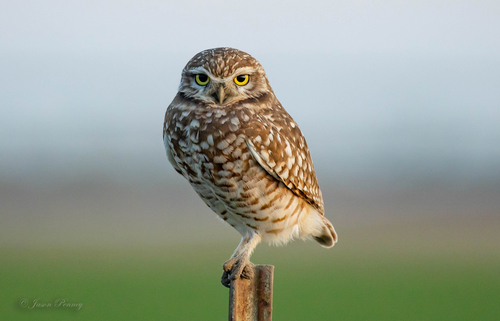
This species, commonly called the burrowing owl, has bright eyes, and beak color that ranges from dark yellow to gray, varying by subspecies. It lacks ear tufts and has a flattened facial disc. Prominent white eyebrows mark the face, alongside a white "chin" patch that the owl expands and displays during certain behaviors, including head bobbing when it becomes agitated. Adult burrowing owls have brown heads and wings marked with white spotting. Their chests and abdomens are white, with variable brown spotting or barring that also differs between subspecies. Juvenile owls have a similar overall appearance, but lack most of the white spotting on their upper bodies and brown barring on their lower bodies. Juveniles have a buff-colored bar across their upper wings, and their breasts may also be buff-colored rather than white. Burrowing owls of all ages have grayish legs that are longer than the legs of other owl species. Males and females are similar in size and overall appearance, so the species shows very little sexual dimorphism. Females tend to be heavier than males, while males tend to have longer linear measurements including wing length and tail length. Adult males appear lighter in color than females, because they spend more time outside the burrow during daylight, and their feathers become sun-bleached. The burrowing owl measures 19–28 cm (7–11 in) in total length, has a wingspan of 50.8–61 cm (20–24 in), and weighs 140–240 g (5–8 oz). As a point of size comparison, an average adult burrowing owl is slightly larger than an American robin (Turdus migratorius). Before European colonization, burrowing owls likely inhabited every suitable habitat across the New World. Since colonization, their distribution has become restricted in parts of North America, while in parts of South America their range is expanding due to deforestation. The subspecies western burrowing owl (A. c. hypugaea) is most common in the Rocky Mountain Arsenal National Wildlife Refuge, as well as across most of the western United States. Confirmed resident populations exist in Colorado, Arizona, New Mexico, Texas and California, where the population is reported to be threatened by human encroachment and construction. Burrowing owls range across the southern portions of the western Canadian provinces of British Columbia, Alberta, Saskatchewan, and Manitoba, extending all the way through Mexico to western Panamá. They are also found throughout the state of Florida, and on some Caribbean islands. In South America, the species is fairly common, and inhabits every country on the continent except the dense interior of the Amazon rainforest and the highest elevations of the Andes Mountains. They prefer cooler, possibly subtropical coastal and temperate regions. South of the Amazon, their population rebounds, and they are widely distributed from southern Brazil and the Pantanal south to Patagonia and Tierra del Fuego. Burrowing owls are year-round residents across most of their range. Individuals that breed in Canada and the northern United States typically migrate south to Mexico and the southern United States for winter. This species can live for at least 9 years in the wild and over 10 years in captivity. Burrowing owls are often killed by vehicles when crossing roads, and have many natural predators including badgers, coyotes, and snakes. They are also killed by both feral and domestic cats and dogs. Two burrowing owls studied in Parque Nacional de La Macarena, Colombia were found to be free of blood parasites. Burrowing owls often nest and roost in burrows dug by ground squirrels, a strategy also used by rattlesnakes. When threatened, the owl retreats into its burrow and produces rattling and hissing sounds that are similar to the sounds a rattlesnake makes. This behavior is thought to be an example of acoustic Batesian mimicry, and has been observed to be an effective defense against animals that recognize the danger of rattlesnakes. When hunting, burrowing owls wait on a perch until they spot prey, then swoop down onto it or fly upward to catch insects mid-flight. Sometimes they chase prey on foot across the ground. Their diet is highly variable, with invertebrates making up roughly one third of their diet and small vertebrates making up the remaining two thirds. Burrowing owls mainly eat large insects and small rodents. Although burrowing owls often live close to ground squirrels (Marmotini), they rarely prey on these squirrels. They also hunt bats. A diet analysis of burrowing owls in the Dominican Republic found that 53% of their diet was invertebrates, 28% was other birds, 15% was reptiles, 3% was amphibians, and 1% was mammals. Rodent prey is usually dominated by locally superabundant species, such as the delicate vesper mouse (Calomys tener) in southern Brazil. Among squamates and amphibians, small lizards like the tropical house gecko (Hemidactylus mabouia), along with snakes, frogs, and toads make up most of the prey. In general, most individual vertebrate prey items weigh only several grams. The largest prey items are usually birds, such as eared doves (Zenaida auriculata) which may weigh almost as much as a burrowing owl, as well as sparrows. Burrowing owls are less generalist when it comes to invertebrates. They are extremely fond of termites in the family Termitidae, and Orthoptera including Conocephalinae and Copiphorinae katydids, Jerusalem crickets (Stenopelmatidae), true crickets (Gryllidae), and grasshoppers. Scarab beetles of the species Bothynus and Dichotomius anaglypticus (Scarabaeidae) are eaten far more often than closely related beetle species by many burrowing owls across central São Paulo, Brazil. Similarly, burrowing owls prefer scorpions in the family Bothriuridae, spiders in the family Lycosidae (wolf spiders), and certain millipedes in the group Diplocheta. Small ground beetles (Carabidae) are eaten in large quantities, while larger ground beetles are much less popular as prey, likely because large beetles can mount a vigorous defense. Burrowing owls also prey on earthworms. Burrowing owls place fecal matter from large herbivorous mammals around the outside of their burrows to attract dung beetles, which provide a steady source of food. They also prey on invertebrates that are attracted to artificial night lighting. Unlike most other owls, burrowing owls also eat fruits and seeds, especially the fruit of tasajillo (Cylindropuntia leptocaulis) and other prickly pear and cholla cacti. On Clarion Island, where mammalian prey is scarce, burrowing owls feed primarily on crickets and prickly pear fruit, and occasionally eat Clarión wrens (Troglodytes tanneri) and young Clarion mourning doves (Zenaida macroura clarionensis).