About Atelopus zeteki Dunn, 1933
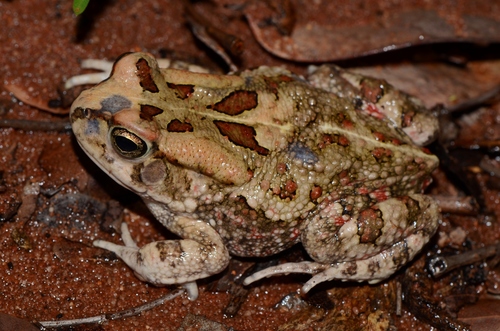
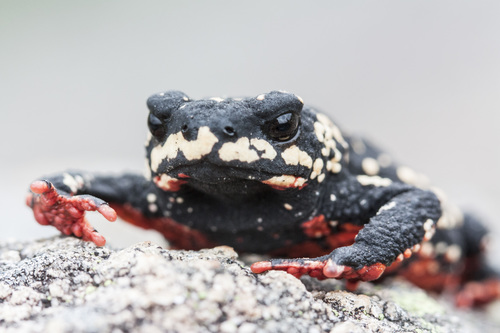
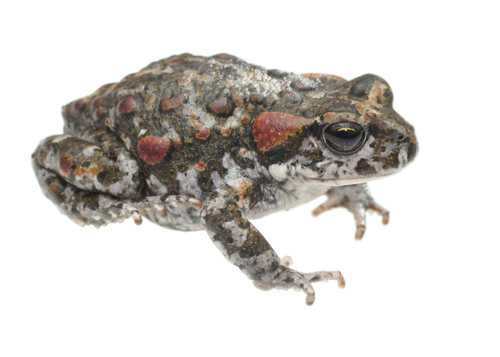
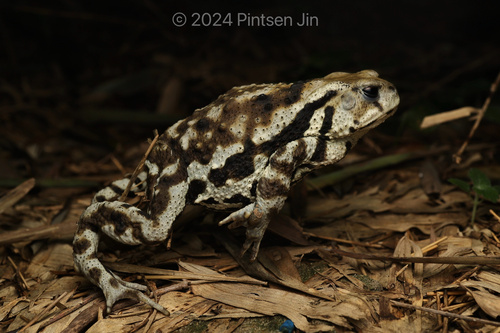
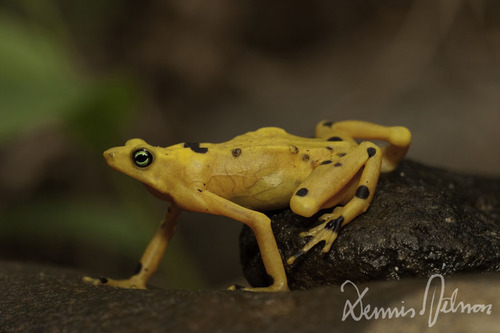
Despite its common name, Panamanian golden frog (scientific name Atelopus zeteki Dunn, 1933) is a true toad belonging to the family Bufonidae. It was originally described as a subspecies of Atelopus varius, but is now classified as a distinct separate species. It is a national symbol of Panama, and is considered one of the most beautiful frogs found in the country. Its skin color ranges from light yellow-green to bright gold, and some individuals have black spots on their backs and legs. Females are generally larger than males. Females are typically 45 to 63 mm (1.8 to 2.5 in) long and weigh 4 to 15 g (0.14 to 0.53 oz), while males are 35 to 48 mm (1.4 to 1.9 in) long and weigh 3 to 12 g (0.11 to 0.42 oz).
Panamanian golden frog is endemic to Panama, where it lives near mountain streams on the eastern side of the Tabasará mountain range in Coclé and Panamá provinces. Before the outbreak of the fungal disease chytridiomycosis, its geographic range once extended as far east as the town of El Copé in western Coclé Province, but the El Copé population rapidly collapsed in 2004 due to the disease. Every year, vital habitat for this species is lost to small farms, commercial agriculture, woodlot operations, livestock grazing ranges, industrial expansion, and real estate development. Captive-breeding programmes for the species currently hold individuals in more than 50 institutions across North America and Panama.
The Panamanian golden frog has a 12-year lifespan. This toad is unusual because in addition to the typical calls used by most frogs, it communicates through a form of semaphore, waving at rivals and potential mates. Researchers believe this adaptation evolved because the fast-moving streams of its natural habitat are very loud, making sound communication less effective. During the breeding season, males tend to remain close to the streams where breeding occurs; in the nonbreeding season, females move back into forested areas. When a female crosses a male's path, the male first uses a soft call to attract her, then grabs and holds onto her. If the female is receptive, she will tolerate amplexus; if not, she will attempt to buck the male off by arching her spine. Amplexus can last from a few days to a few months, and oviposition (egg-laying) usually occurs in a shallow stream.
Panamanian golden frogs produce a range of toxins, including steroidal bufadienolides and guanidinium alkaloids from the tetrodotoxin class. One of these alkaloids, zetekitoxin AB, is a blocker of voltage-dependent sodium channels, and is several orders of magnitude more potent than its analog saxitoxin. The toxin is water-soluble, and affects the nerve cells of any person who comes into contact with it. The frogs use this toxin to defend themselves against most predators. Because testing this poison on humans is too dangerous, toxicity testing has been carried out on mice. In mice, large doses can cause death within 20 to 30 minutes. Death is preceded by clonic (grand mal) convulsions, which continue until circulatory and respiratory system functions stop.