About Atelopus spurrelli Boulenger, 1914
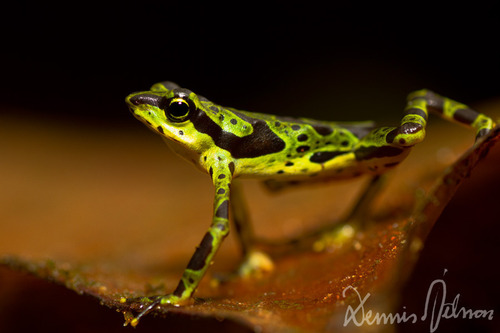
Description: Male Atelopus spurrelli reach a snout–vent length of 26 mm (1.0 in), while females grow to 34 mm (1.3 in). This species has an elongated body, and a head that is as long as it is wide. Its skin ranges from smooth to finely granular. The dorsum is dark brown to black with irregular yellow to olive green spots, and the belly is uniformly cream to white with small brown spots. The skin of Atelopus spurrelli contains tetrodotoxin, though it has less of this toxin than Atelopus spumarius and Atelopus varius. Habitat and conservation: Atelopus spurrelli lives in primary and secondary tropical humid forest, at elevations between 50–900 m (160–2,950 ft) above sea level. It inhabits leaf-litter near water, and is presumed to breed in streams. This species can be locally common, but it has declined or completely disappeared from many sites where chytridiomycosis has been recorded. It is also locally threatened by deforestation driven by agricultural development, illegal crops, illegal mining, and logging. The species' range includes multiple protected areas, such as Utría National Park and El Amargal Nature Reserve.