About Atelopus laetissimus Ruiz-Carranza, Ardila-Robayo & Hernández-Camacho, 1994
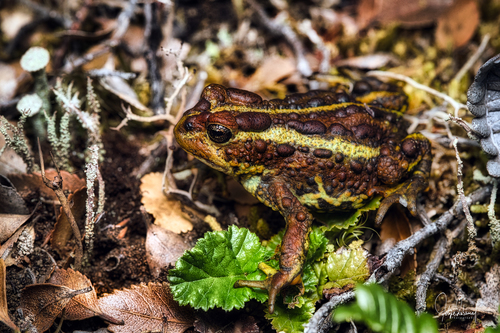
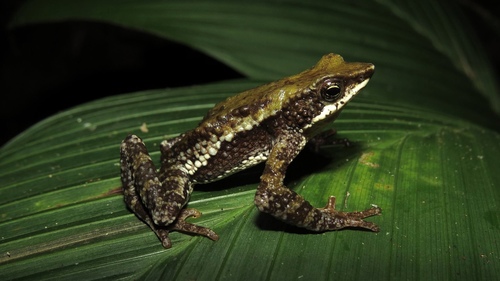
Atelopus laetissimus is a harlequin toad species formally described by Ruiz-Carranza, Ardila-Robayo & Hernández-Camacho in 1994. In terms of physical characteristics, adult males measure 35 to 39 mm (1.4 to 1.5 in) in snout–vent length. Only one adult female specimen has been recorded, which measures 54 mm (2.1 in) in snout–vent length. When viewed from above, the snout is acuminate in males and sub-acuminate in the known female. A tympanum is not present in this species. Fingers show only traces of basal webbing. Toes are fully webbed from toe I through toe III, and partially webbed on toes IV and V. Skin on the front portion of the head is smooth, while the rest of the skin has granules, tubercles, and warts; these texture features are especially prominent in the area where a tympanum would typically sit. Dorsal coloration ranges from olive green, yellowish olive, to ocher, and is marked with spots. There is a dark brown X-shaped mark between the eyes and the suprascapular area, which also bears spots, and an inverted V-shaped dark marking on the back. Ventral coloration can be olive, cream, or rust, patterned with light green, pale lilac, or brown spots, specks, or vermiculations. This species' natural habitats are sub-Andean forests located between 1,900–2,880 m (6,230–9,450 ft) above sea level. It has been recorded in both closed-canopy secondary forest and riparian forest. Breeding for this species occurs in streams. Atelopus laetissimus is currently only known from three geographically separated locations. Its overall populations appear to be stable, and the species is even locally abundant, but almost all observed individuals are male. Habitat loss is a major threat to the species, as ongoing conversion of forest into pasture lands poses an acute threat to one of the three known populations. The species is also potentially threatened by chytridiomycosis, though as of 2014, the disease had not been detected in the Sierra Nevada de Santa Marta region. It occurs within the protected area of Sierra Nevada de Santa Marta National Park, as well as in the adjacent El Dorado Nature Reserve.