About Ateles marginatus É.Geoffroy Saint-Hilaire, 1809
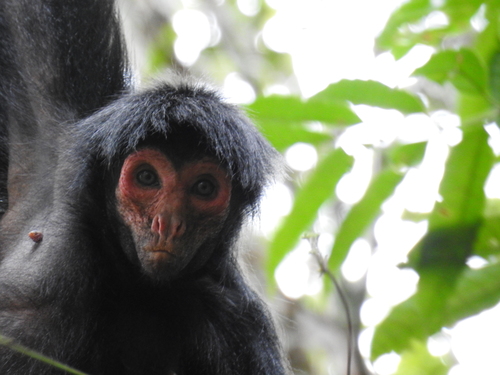
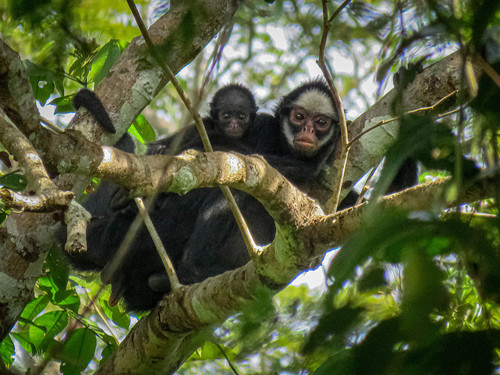
The white-cheeked spider monkey (Ateles marginatus) is a species of spider monkey, a type of New World monkey that is endemic to Brazil. It moves through the forest canopy in small 2–4 individual family groups, which are part of larger groups that can include a few dozen animals. This monkey’s diet includes leaves, flowers, fruits, bark, honey, and small insects, and it acts as an important seed disperser for forest trees. Females give birth after a gestation period around 230 days. The species’ population is decreasing, as its forest habitat is lost to soybean production, deforestation, and road construction. It is also hunted for food, as its meat is considered a delicacy. For these reasons, the International Union for Conservation of Nature has assessed the species’ conservation status as Endangered. This monkey is native to the Brazilian Amazon. Its core range lies south of the Amazonas River, between the right bank of the Rio Tapajós, the right bank of its tributary the Rio Teles Pires/Sao Manuel, and the left bank of the Rio Xingu. Portions of the species’ territory fall within several Brazilian national forests: Tapajós National Forest (545,000 hectares / 1,350,000 acres), Xingu National Forest (252,790 hectares / 624,700 acres), Altamira National Forest (689,012 hectares / 1,702,590 acres), Itaituba I National Forest (220,034 hectares / 543,720 acres), and Itaituba II National Forest (440,500 hectares / 1,088,000 acres). When feeding and resting, the white-cheeked spider monkey typically travels in small groups of 2 to 4 individuals. The species reaches sexual maturity at around 4 to 5 years of age. After a gestation period of 226 to 232 days, females produce a single offspring; in the wild, the interval between births can be 28 to 30 months long. Its full diet includes fruit, leaves, flowers, aerial roots, bark, decaying wood, honey, and small insects such as termites and caterpillars. A key ecological role of the white-cheeked spider monkey is seed dispersal for numerous plant species across its range; it is thought to disperse seeds for as many as 138 different fruit species.