About Ateles hybridus I.Geoffroy Saint-Hilaire, 1829
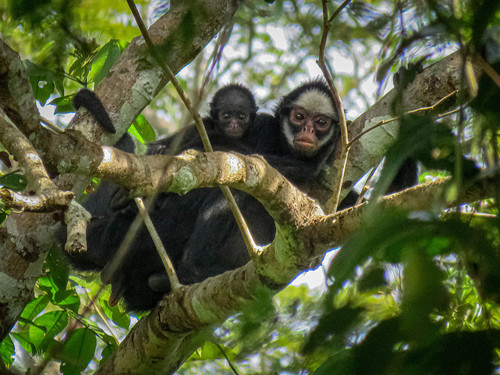
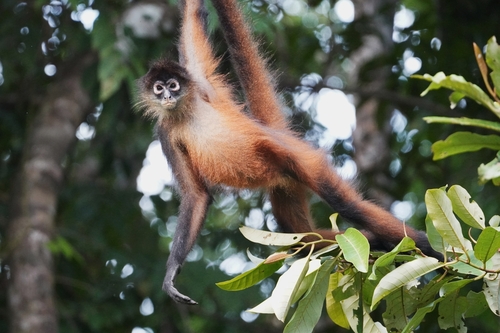
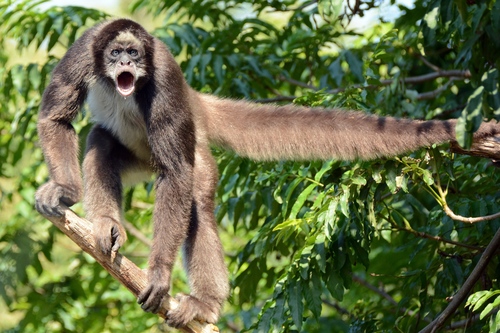
This species, commonly called the brown spider monkey, has long thin limbs, with forelimbs longer than hind limbs. It has a distinctive, 75 cm (30 in) long flexible, thin prehensile tail that can act like a fifth limb. The tail has a highly flexible, hairless tip with skin grooves that improve grip. Brown spider monkeys have four curved fingers and lack thumbs, an adaptation that helps them swing between trees. These traits let them climb trees at great heights, hang and swing between trees, and rarely need to return to the ground. Adult males weigh between 7.9 and 9.1 kg (17 and 20 lb), while adult females weigh between 7.5 and 9 kg (17 and 20 lb). Average adult body length is around 35 to 70 cm (14 to 28 in). Upper body coloration, including the head, ranges from light brown to dark brown. Its most notable feature is a whitish triangular patch on the forehead, though not all individuals have this mark. Some individuals have pale blue eyes, but most have brown eyes. In the wild, brown spider monkeys typically live 10 to 27 years, with an average lifespan of around 22 years; captive individuals can live up to 40 years. This species is found in northern Colombia and northwestern Venezuela. In Colombia, its range covers the right bank of the Magdalena River in Magdalena and Cesar Departments, the southwestern portions of Guajira in the northernmost parts of the Serrania de Perija, and the middle Magdalena River Valley at least as far as Caldas and Cundinamarca Departments. In Venezuela, it is usually found at altitudes between 20 and 700 m (66 and 2,297 ft). Its inter-Andean forest habitat is shrinking due to mining, infrastructure development, and other industrial activities. The species recovers slowly from population loss because of its low reproductive rate: individuals typically reproduce only once every 2–3 years. Brown spider monkeys spend most of their time high in trees, but will occasionally descend to the ground to eat soil and drink water. They forage in high canopies, so they prefer undisturbed primary forests. They travel in small groups, and move mostly by climbing and swinging between trees rather than walking or running on all fours. They forage mainly in the forest canopy, and rely on sight, smell, taste, and touch to locate food. They are primarily herbivorous and frugivorous, with ripe fruit making up the main component of their diet. More than three-quarters of their diet consists of lipid-rich fruits. When fruit is less abundant during dry seasons, they feed on leaves, seeds, flowers, bark, honey, and decaying wood, and occasionally eat insects such as termites and caterpillars. They feed on different fig species year-round. Scientists have observed brown spider monkeys eating soil and clay, and hypothesize this behavior may allow them to obtain minerals like phosphorus, or help maintain pH balance in their digestive system. They access drinking water on the forest floor at "salado sites". Food competition occurs between brown spider monkeys and other frugivorous primates. Fragmentation of the land they inhabit causes variation in their social behavior and ranging patterns. Male-to-female aggression is common and consistent; it acts as a social control mechanism, serving as an indirect form of sexual coercion or a form of ritualized courtship. Their natural predators include jaguars (Panthera onca), mountain lions (Puma concolor), harpy eagles (Harpia harpyja), and crested eagles (Morphnus guianensis). To ward off potential predators, brown spider monkeys shake tree branches.