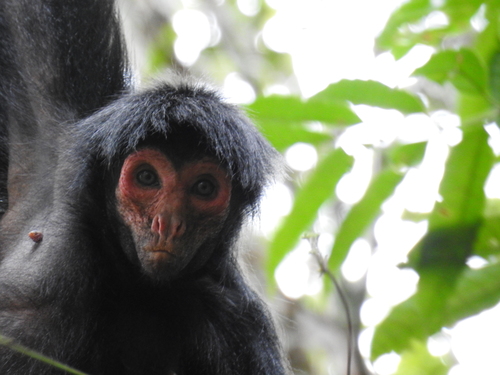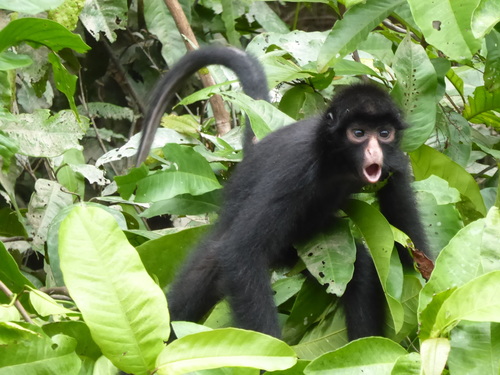
About Ateles chamek (Humboldt, 1812)
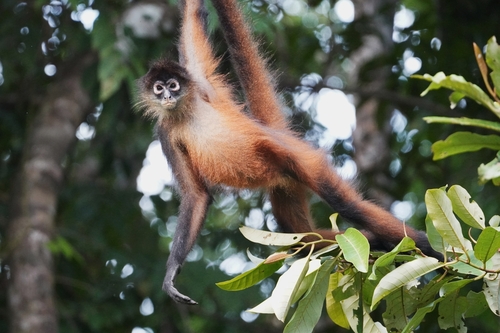
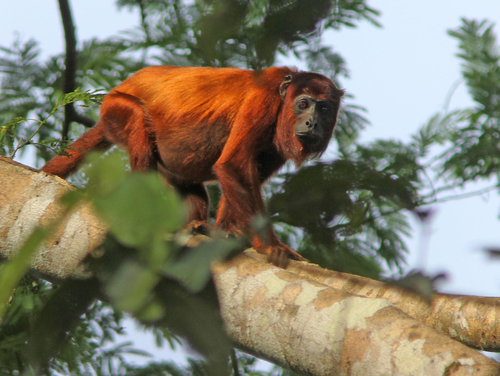
Peruvian spider monkey (Ateles chamek) can weigh up to 9 kilograms (20 pounds). Its body reaches 70 cm (28 in) in length, while its prehensile tail can grow to 1 m (40 in) long. Like other spider monkeys, it has four elongated fingers and virtually no thumb, a trait that is unusual for most other monkey species. Its prehensile tail, a shared trait of all species in the genus Ateles, helps it move through trees during brachiation. Its agility is matched only by Asian gibbons. The species has a maximum lifespan of 20 years. This species is distributed in north-central Bolivia, northeastern Peru, and the central-western Brazilian Amazon. It was recently discovered to live on the northern bank of the Solimões River in the Mamirauá Reserve, where it most likely colonized the area through a river meander cutoff process. Peruvian spider monkeys primarily live in lowland forests, where they occupy the canopy and sub-canopy, but they have been observed in a range of other habitat types, including dry, hilly areas like piedmont and cerrado forests. They also live in Amazonian seasonally flooded forests. Their movement between habitats depends on food availability. They live in territorial social bands of 6–12 individuals, whose territory covers around 20 square kilometers. Band size changes somewhat with the season, likely because females leave the band for a few months to give birth, most often in the fall. Peruvian spider monkeys compete with other spider monkeys, woolly monkeys, and howler monkeys for food and territory. Reproduction can occur throughout the year for this species, though most births happen at the start of autumn. The gestation period lasts around 140 days. Pregnant females leave their social group to give birth, and return 2 to 4 months after birth. Newborn Peruvian spider monkeys become independent at around 10 months of age. The diet of the Peruvian spider monkey includes leaves, berries, small animals such as birds and frogs, flowers, termites, honey, grubs, fruits, insects, baby birds, and bird eggs. It is primarily frugivorous, and tends to shift to folivory when fruit is scarce. In the Amazon, Peruvian spider monkey groups show strong seasonal changes in habitat use that correspond to the availability of fleshy fruits. The foraging habits of this species make it an important contributor to seed dispersal for many Amazonian tree species.