About Ateles belzebuth É.Geoffroy Saint-Hilaire, 1806
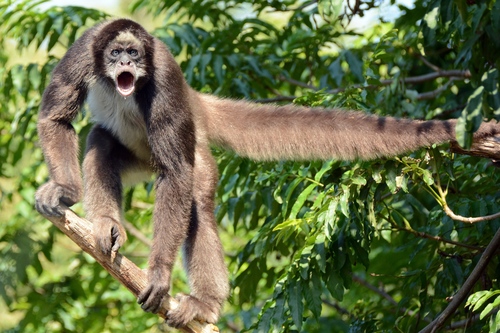
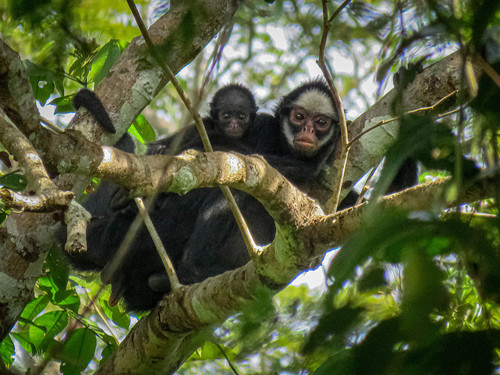
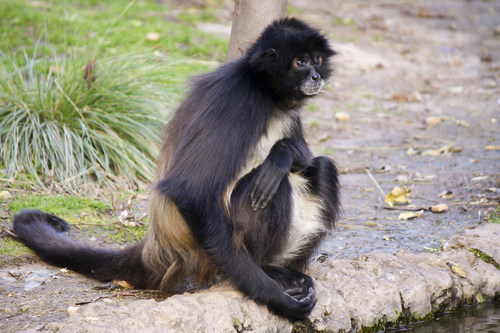
The white-bellied spider monkey (Ateles belzebuth), also called the white-fronted or long-haired spider monkey, is an endangered species of spider monkey, which is a type of New World monkey. It is native to the northwestern Amazon, occurring in Colombia, Ecuador, Venezuela, Peru, and Brazil, with its range extending south to the lower Ucayali River and east to the Branco River. Historically, Peruvian spider monkeys, brown spider monkeys, and white-cheeked spider monkeys were classified as subspecies of A. belzebuth; under its current definition, the white-bellied spider monkey is a monotypic species. It has a whitish belly and a pale patch on the forehead. Despite its common name, this forehead patch is often orange-buff, which may be caused by dirt and other stains. This species lives in larger groups of 20 to 40 individuals, which split into small active parties of between 1 and 9 individuals. In Colombia, local common names for this species include mono prieto, mico prieto, and marimonda. Over the past 45 years, equal to 3 generations, the total population has declined by approximately 50%, driven by habitat loss and hunting. Because of this population reduction, the IUCN lists A. belzebuth as Endangered. White-bellied spider monkeys act as important long-distance seed dispersers for many fruit-bearing plant species, and they are the dominant disperser of the palm species Oenocarpus bataua. A. belzebuth typically occupies a large home territory and uses multiple different nesting trees across this range. Seeds from the plant species the monkeys prefer are often dispersed below their sleeping trees. Their social groups follow fission-fusion dynamics: the larger group splits into smaller subgroups that travel, feed, and sleep together. These groups have very fluid structure, and subgroup composition changes often, sometimes multiple times a day. Subgroup composition can be affected by the reproductive status of female group members. Females are generally more solitary than males. Females with dependent offspring are more likely to join large groups than females without dependent offspring. Females typically stay within small core areas of the group’s home range with their offspring, while males make use of a larger portion of the full home range. Long-distance vocalizations, which can be heard up to one kilometer away, bring separate subgroups back together. When two subgroups reunite after foraging separately, they greet each other excitedly through vocalizing, chasing, hugging, and sniffing each other’s pectoral glands. There is no documented evidence of secondary dispersal in wild spider monkeys of this species, so males within a single social group are closely related to one another. White-bellied spider monkeys are thought to reach sexual maturity between 4 and 5 years of age. Females usually produce a single offspring per birth, though the birth of twins has been recorded. Gestation lasts between 226 and 232 days. Copulation is initiated by females; this pattern of greater female mate choice, which is also seen in other spider monkey species, is thought to reduce aggression among males. Males of this species have been observed committing infanticide. All recorded infanticide victims were young males that belonged to the same social group as their attackers.