About Atelerix albiventris (Wagner, 1841)
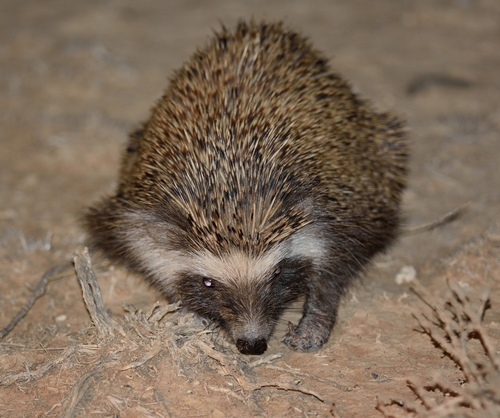
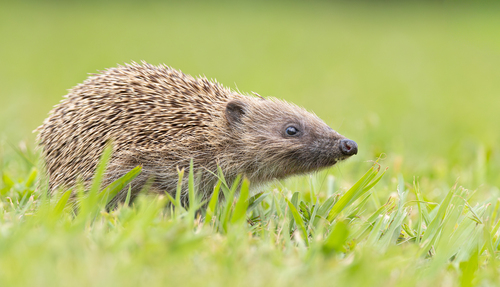
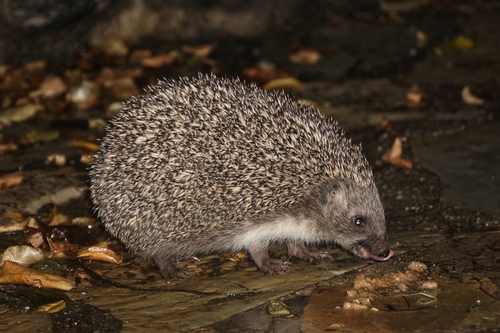
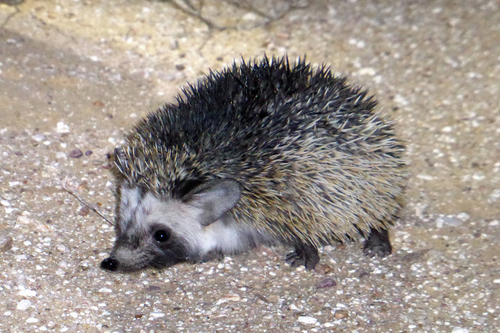
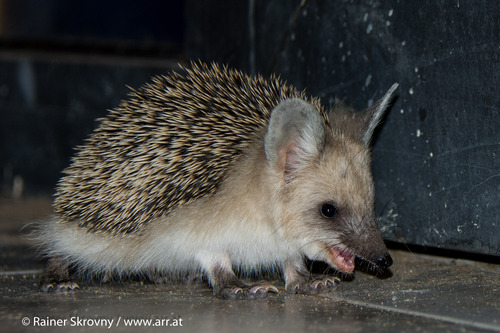
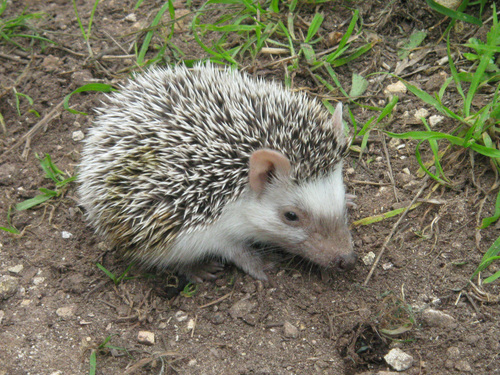
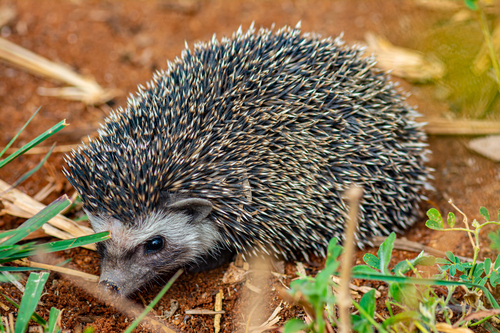
The four-toed hedgehog, scientifically named Atelerix albiventris (Wagner, 1841), has an oval body shape. It reaches approximately 210 millimetres (8.3 in) in length and weighs between 250 and 600 grams (8.8 and 21.2 oz), and females are typically larger than males. It has short legs, a short tail that is typically around 2.5 centimetres (0.98 in) long, a long nose, and small beady eyes. Both its ears and whiskers are relatively large, indicating the animal has well-developed senses. As its common name suggests, this species differs from related hedgehog species by typically having only four toes on each hind foot, and lacks the hallux (big toe). However, some individuals may have a small bony lump in the place of the hallux, or even a fully developed toe, particularly on the hind feet. Four-toed hedgehogs can vary widely in coloration. Most wild specimens have brown or grey spines with white or cream-colored tips. Their body fur is speckled grey, with brown coloration around the muzzle, and white fur on the face, legs, and underparts. Their upper bodies are covered in spines that range from 0.5 to 1.7 centimetres (0.20 to 0.67 in) in length, with the longest spines located on the upper surface of the head. While individual spine color varies, all spines have both a white base and a white tip. Males have an externally visible penis positioned in the mid-abdomen, but their testicles are recessed into pouches near the anus. Females may have between two and five pairs of teats.
This species is found across a wide area of central Africa, extending from Gambia and Senegal in the west to Somalia in the east; it is also present in eastern Africa as far south as Mozambique. It prefers grassy habitats or open woodland, and can be found at elevations up to 2,000 metres (6,600 ft), though it is more common in lowland areas. It favors shelter in dry rocky or grassy areas, so it avoids dense forest and swampland. The main predators of four-toed hedgehogs within their natural range are Verreaux's eagle-owl, jackals, hyenas, and honey badgers. This species prefers temperatures between 24 and 30 °C (75 and 86 °F). When temperatures rise above this range, it shelters in burrows and enters a state of estivation; when temperatures drop below it, it enters hibernation to conserve energy.
Female four-toed hedgehogs do not enter estrus on a fixed seasonal cycle, and remain fertile throughout the year, though mating is most common during the rainy season when food is most abundant. Females typically produce just one litter per year, which can hold between two and ten hoglets, with four or five being the most common litter size. Males approach females and court them using high-pitched vocalizations. Ovulation in this species is induced: it only occurs when a male is present, normally within 24 hours of mating. Gestation lasts 30 to 40 days, and females give birth in a well-lined nest cavity such as an abandoned rodent burrow. Newborn hoglets are covered in a thin membrane to protect the mother from their already-formed spines; the young take some time to gain control over the muscles that move their spines. At birth, young weigh around 10 grams (0.35 oz), are blind and helpless, and only have soft spines with no other fur. Their initial spines stiffen within a few hours, and additional spines emerge over the first few days of life as the newborn's initially swollen and edematous skin dries and contracts. The young's eyes open at 15 days of age, when they begin to become more active. Deciduous teeth emerge at around three weeks, and permanent teeth grow in between seven and nine weeks of age. The young are weaned by six weeks old, and leave their mother shortly after weaning. They can reach sexual maturity at two to three months of age, though they do not typically breed during their first year of life in the wild. In the wild, four-toed hedgehogs live no longer than around three years, but individuals have lived up to ten years in captivity.