About Atalopedes campestris (Boisduval, 1852)
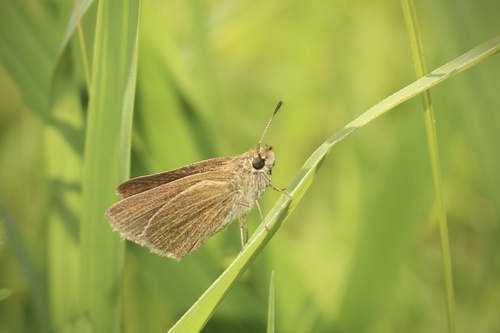
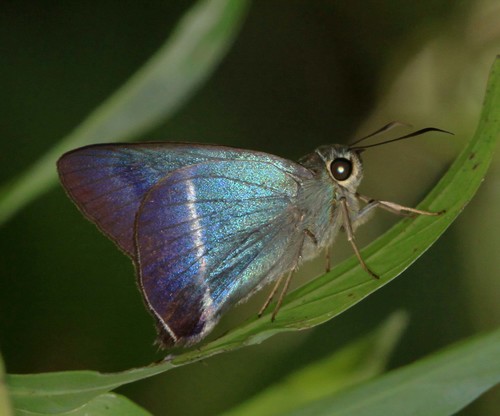
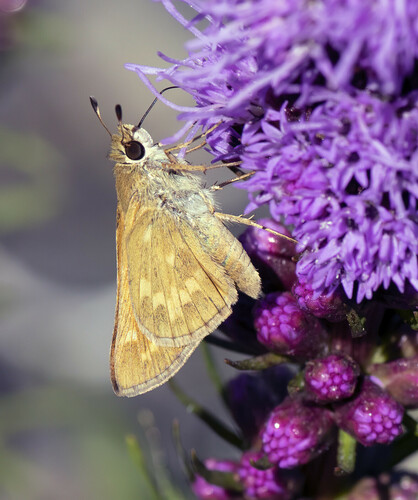
This species, the sachem, has a scientific name of Atalopedes campestris (Boisduval, 1852). Its wingspan measures 35–41 mm (1+3⁄8–1+5⁄8 inches). Males and females look different from each other, but both have elongated wings. On the upperside of the male's forewing, the main color is orange with a brown border, and it has a large four-sided black stigma. The upperside of the female's wings is dark brown overall, with golden spots in the center; female wing color is highly variable, ranging from light to very dark. The upperside of the female's forewing has a black median spot and several semi-transparent spots. Females can always be identified by the square white transparent spot located at the end of the forewing cell. The underside of the wings of both sexes is variable, but the underside of the female's hindwing is brown with light-colored four-sided spots. The sachem is often mistaken for other skipper butterflies in the genus Hesperia. In 2022, the population living in the eastern part of the continent was designated as a separate species: A. huron, the huron sachem. This skipper is common in the southern United States, and its range extends south through Mexico and Central America to Colombia, Venezuela, Ecuador, and Brazil. During warmer months in North America, it can be found in northern parts of the continent up to Montana, Washington, and New York, and it is absent from most of the Rocky Mountains. One individual was sighted and photographed in southern Manitoba, Canada, on July 11, 2015. Stray individuals have been reported in British Columbia, Canada, three times: once each in 1937, 1953, and 1960. Atalopedes campestris lives in open, disturbed areas including roadsides, lawns, pastures, parks, oil fields, and landfills. Observations show that the sachem rapidly expanded its range northward during the early 21st century. A study by Crozier found that this range expansion is caused by the winter warming trend of climate change, rather than the evolution of increased cold tolerance in this species. The sachem butterfly goes through four stages of complete metamorphosis.