About Astyanax bimaculatus (Linnaeus, 1758)
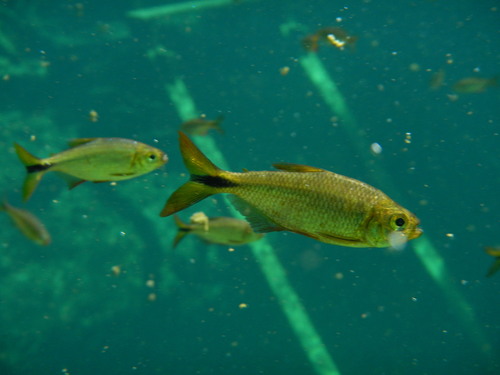
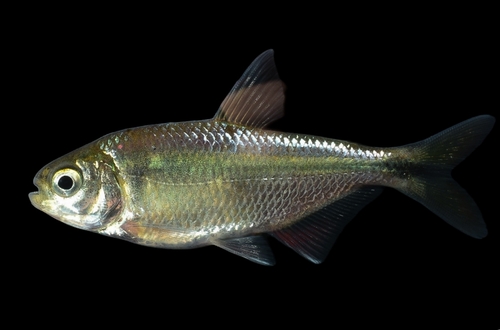
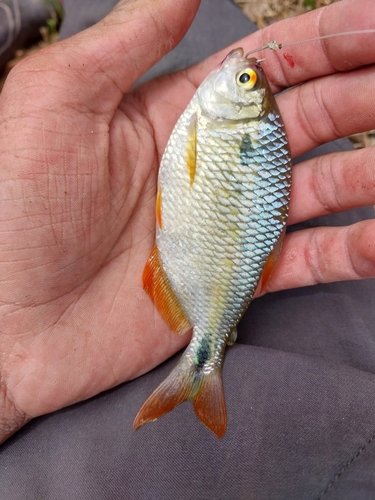
Astyanax bimaculatus reaches a maximum total length of 17.5 cm (6.9 in), and a maximum weight of 91.6 g (3.23 oz). Its scales are large, and do not have distinct radii that originate from a single point at the center of each scale. The presence of these radial lines was once incorrectly attributed to A. bimaculatus, and has since been confirmed to be a trait of the related species A. abramis. This species has 33 lateral-line scales, 26–27 dorsal-fin rays, and 26–30 anal-fin rays. Before recent taxonomic revisions, the reported range of variation in fin-ray and lateral-line scale counts was much wider, because multiple separate species were all grouped under the single name A. bimaculatus. The back of A. bimaculatus is dark-green, the sides are silver-yellow, and a distinct silver lateral stripe runs along the flank. The base of the dorsal fin and the upper lobe of the caudal fin may be a strong red, pink, or yellow, while the rest of the fins show reduced coloration. A. bimaculatus has a prominent black humeral spot, and another large dark pigment blotch at the base of the caudal fin that extends onto the middle caudal-fin rays. These two dark spots are shared by all members of the A. bimaculatus species complex, and are often considered one of the defining characteristics of the complex, though a small number of species in the complex, including A. elachylepis and A. varzeae, do not have this trait. Markings that are also characteristic of this complex include two brown vertical bars in the humeral region.
Astyanax bimaculatus has an extremely large distribution. The rivers and basins where it occurs include, but are not limited to: Amazonas estuaries and main channel, Apure, Araguaia, Atrato, Beni-Madre de Dios, Branco, Cauca-Magdalena-Sinu, Coppename, Suriname, Saramacca, Corentyne-Demerara, Essequibo, Guapore, Itapicuru-Mearim, Iapura, middle-lower Madeira, Mamore, Maroni-Approuague, Oiapoque, upper and lower Orinoco, Parnaiba, Purus, Putumayo, upper Tocantins, Ucayali, and upper Xingu. Though A. bimaculatus is generally considered sedentary, it and other members of its species complex can make short-distance migrations when needed.
Due to its very large range, A. bimaculatus is tolerant of a wide range of environmental conditions. It is entirely potamodromous, meaning it lives exclusively in freshwater, and generally prefers water with a pH between 5.5 and 7.5. Even so, it can survive for long periods in suboptimal conditions; a 1942 documentation by zoologist William Beebe gives one example: a variety of aquatic life was stranded in a pond that had shrunk to a mud puddle during the severe dry season in Caripito, Venezuela. Of 32 A. bimaculatus individuals trapped there, 12 remained alive in conditions that should not have supported their survival for as long as they persisted.
Astyanax bimaculatus can reproduce year-round, though individuals are less likely to be in an active reproductive or maturation state during May, June, and July. When resources are scarce, female specimens can redirect energy stored in body fat or the liver to their gonads; males do not use this strategy. Males also have reproductive morphology that is considered more "primitive" in phylogenetic terms, including the structure that forms and carries sperm cells. The peak of the spawning period, which may vary by location, has been recorded in January and February. Female specimens exposed to a chemical signal called "conspecific alarm substance", which is released by other A. bimaculatus during stressful events like predator attacks, ovulate earlier than unexposed females. However, exposed females only ovulate once, and the resulting zygotes may not develop. Under normal spawning conditions, larger females can lay more eggs, simply because they have more internal space to carry eggs. The eggs of A. bimaculatus are weakly adhesive, and are laid in low-current environments. Spawning of this species has been successfully achieved in captivity.